Your insurance adjuster isn’t viewing your wrecked vehicle as a vital part of your daily life. To them, it’s a line item on a balance sheet that needs to be minimized as quickly as possible. When you’re managing a car accident property damage claim CT, the gap between a fair payout and a low-ball offer often comes down to your level of tactical preparation. It’s frustrating to realize that even a perfectly repaired car might lose thousands in resale value just because it now carries an accident history. You shouldn’t have to absorb the financial hit for a collision you didn’t cause.
We understand the weight of this burden and the urgency of getting your life back in motion. You deserve more than just a functional vehicle; you deserve to be made financially whole. This guide will show you how to navigate the complexities of total loss valuations and rental car coverage with military-grade precision. We’ll explore the specific steps required to secure compensation for diminished value and ensure that hidden costs like towing and storage fees are fully covered by the at-fault party’s insurer.
Key Takeaways
- Identify exactly what constitutes property damage in Connecticut and how to secure your vehicle immediately after a collision to prevent further loss.
- Learn how to navigate the 80% total loss threshold and ensure you receive a fair market valuation rather than a low-ball settlement.
- Discover the strategy for recovering diminished value, ensuring you’re compensated for the permanent loss in resale worth caused by an accident history.
- Master the documentation required for a car accident property damage claim CT by gathering high-impact evidence and detailed repair estimates.
- Recognize the tactical moments when legal intervention is necessary to force insurers to honor their obligations and cover all your losses.
Call For A Consultation
(860) 333-6455Table of Contents
Understanding Property Damage Claims in Connecticut
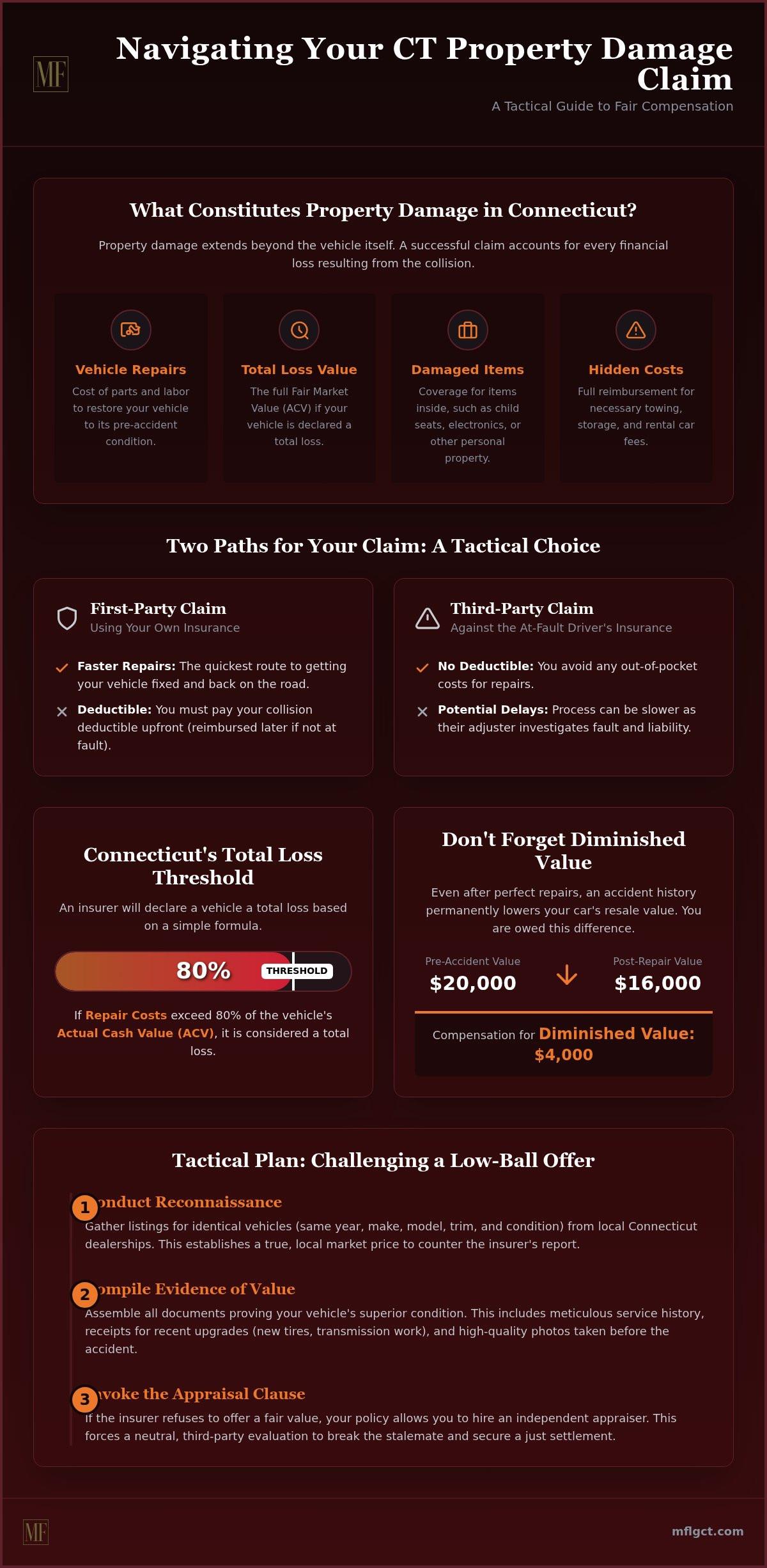
In Connecticut, property damage isn’t limited to a crumpled bumper. It encompasses the full financial loss of your vehicle’s utility and the destruction of items inside it. This includes the cost of parts and labor for repairs, the fair market value if the car is declared a total loss, and even secondary items like child safety seats or electronics damaged in the impact. A successful car accident property damage claim CT requires a tactical approach to ensure every cent of this loss is accounted for by the insurance carriers involved.
You’ll likely notice that your property damage claim moves on a different track than any personal injury claim. This is a strategic separation. While medical treatments and injury settlements can take months or years to resolve, you need your vehicle back on the road immediately to maintain your livelihood. Resolving the vehicle portion first allows you to regain mobility while your legal advocate continues the longer battle for your physical recovery. We treat this as an initial objective in a larger mission to restore your stability.
Your mission starts the moment the dust settles. Secure the vehicle to prevent further loss. If a window is smashed, it must be covered to prevent rain damage. If the vehicle is sitting on a tow lot, move it to a repair facility quickly to stop storage fees from mounting. Insurance companies look for any excuse to reduce their payout. Don’t give them an opening by failing to mitigate damages. This disciplined approach protects your right to full compensation.
The Two Paths: First-Party vs. Third-Party Claims
Choosing between your own policy and the at-fault driver’s insurance is a matter of tactical priority. Filing a first-party claim with your own collision coverage is often the fastest route to repairs, though you’ll have to pay your deductible upfront. Conversely, a third-party car accident property damage claim CT against the other driver’s liability policy avoids the deductible, but it often involves delays while their adjuster investigates fault. We help you weigh these options based on the clarity of the accident scene and your immediate need for transport.
Connecticut General Statutes and Your Rights
Connecticut law provides you with specific protections that insurance adjusters rarely volunteer. Under CGS § 38a-354, you have the absolute right to choose the repair shop that works on your vehicle. You aren’t required to use the “preferred” shops suggested by the insurance company. You should also be aware of Diminished Value, which accounts for the loss in resale worth after a car is repaired. The ‘Made Whole’ doctrine in Connecticut dictates that an insurance settlement must restore you to the exact financial position you occupied before the collision occurred.

Call For A Consultation
(860) 333-6455Total Loss Valuation: How Insurers Calculate Your Car’s Worth
The insurance company’s valuation of your vehicle isn’t an objective fact; it’s a opening position in a high-stakes negotiation. In Connecticut, insurers typically declare a vehicle a total loss if the cost of repairs reaches a specific threshold, often 80% of the car’s retail value. This is a cold, mathematical calculation designed to protect the insurer’s bottom line. When managing a car accident property damage claim CT, you must understand that the adjuster is looking for the Actual Cash Value (ACV). This is the market value of your car the second before the crash, not the amount you originally paid or the price of a brand-new replacement.
Adjusters use specialized software to generate “valuation reports” based on comparable vehicles sold recently in the region. However, these reports are frequently flawed. They might use “comps” from across the state that don’t reflect the higher market prices in areas like New Haven or Groton. They also tend to overlook recent investments you’ve made. If you just installed a new set of tires, upgraded the transmission, or maintained a meticulous service history, the software won’t automatically account for that added value. You have to prove it.
Challenging a Low Valuation Tactical Plan
Don’t accept a low-ball settlement as final. Conduct your own reconnaissance by gathering listings for identical vehicles from local Connecticut dealerships to establish a realistic market price. Compile every maintenance receipt from the last twelve months to demonstrate that your vehicle was in superior condition. If the insurer refuses to budge, you can trigger the “Appraisal Clause” found in most CT auto policies. This mechanism allows you to hire an independent appraiser to challenge the insurer’s figure, often forcing a more favorable settlement through a neutral umpire. This level of strategic legal preparation is often the only way to ensure you aren’t financially sidelined by a computer-generated estimate.
What Happens to Your Title After a Total Loss?
When a vehicle is totaled, the insurance company essentially buys the wreckage from you. If you choose to keep the car, perhaps because the damage is cosmetic and you want to repair it yourself, the insurer will deduct the “salvage value” from your payout. Connecticut will then issue a salvage title, which permanently flags the vehicle’s history and lowers its future resale value. If you have an outstanding loan, the insurer is legally obligated to pay the lienholder first. If the ACV is lower than your loan balance, you’ll be responsible for the “gap” unless you have specific gap insurance coverage in place.

Call For A Consultation
(860) 333-6455Diminished Value: Recovering Lost Resale Worth After Repairs
Most drivers believe that once the body shop returns their keys and the paint looks factory-fresh, their financial loss has been fully mitigated. This is a tactical error. Even if your car is restored to its pre-crash physical condition, its market value has suffered a permanent hit. This is known as inherent diminished value. In the secondary market, a vehicle with an accident history is perceived as damaged goods. If you were to list that car for sale in New Haven or Groton tomorrow, savvy buyers would demand a steep discount compared to an identical vehicle with a clean history. A comprehensive car accident property damage claim CT must account for this “stigma” loss to truly make you whole.
Insurance companies are well aware of this financial reality, yet they rarely volunteer this compensation. They bank on the hope that you’ll be satisfied with the repair bill being paid. In Connecticut, you generally have the right to pursue a diminished value claim against the at-fault driver’s insurance policy. However, proving the exact dollar amount of that loss requires disciplined preparation and authoritative evidence. It isn’t enough to simply state the car is worth less; you must quantify the loss with precision to overcome the insurer’s resistance.
Calculating Diminished Value in CT
Insurers often rely on a rigid calculation known as the “17c formula” to cap their liability. This formula is frequently criticized because it uses arbitrary caps on mileage and damage levels that don’t reflect the actual Connecticut used-car market. We favor a more aggressive approach that utilizes real-world market data and professional appraisals. Because a Carfax report permanently flags a vehicle’s collision history, it serves as an irrefutable record of the vehicle’s diminished market appeal regardless of the quality of the repairs. For high-value or newer vehicles, a certified appraisal is the “heavy artillery” needed to force an adjuster to acknowledge the true scale of your loss.
Strategic Advocacy for Diminished Value
Timing is a critical factor in your recovery strategy. You cannot accurately file for diminished value until all repairs are completed, as the final quality of those repairs can influence the total loss in value. Your evidence file should include a comparison between your vehicle’s pre-accident retail value and documented trade-in offers received after the repairs. This data creates a clear line of sight for the adjuster, showing exactly how much equity was stripped away by the collision. Securing Maximum Compensation for Your Connecticut Accident Claim requires looking beyond the immediate repair costs to the long-term financial impact on your assets.
Mission-Critical Steps for Property Damage Documentation
In the aftermath of a collision, information is your most valuable asset. Your ability to secure a fair settlement for a car accident property damage claim CT depends entirely on the quality of your evidence. Initial reconnaissance should go beyond simple snapshots of a dented fender. Capture high-resolution video of the entire scene, including skid marks, obscured traffic signs, and the position of all vehicles involved. This visual data acts as an objective witness that insurance adjusters cannot easily dismiss. If you don’t document it now, it effectively didn’t happen in the eyes of the insurance company.
Don’t forget the interior of your vehicle. Initiate an “inventory mission” to list every personal item damaged in the crash. Child safety seats, for example, must often be replaced after any significant impact regardless of visible damage. List every damaged item, from broken sunglasses to shattered electronics, and secure original purchase receipts whenever possible. Additionally, treat every interaction with an adjuster as a recorded event. Maintain a rigorous communication log that notes the name, date, time, and specific details of every phone call or email. This log prevents the insurer from moving the goalposts or “forgetting” promises made during negotiations.
The Role of the Independent Repair Shop
Insurance companies often push you toward their “preferred” repair shops. These facilities frequently have pre-negotiated labor rates with the insurer, which can lead to a conflict of interest. An independent shop works for you, not the insurance carrier. They are more likely to identify hidden damage, such as hairline frame fractures or compromised suspension components, that a cursory adjuster’s estimate might overlook. If new damage is discovered once the teardown begins, your shop will submit “supplemental” repair requests. We ensure these supplements are approved so your vehicle’s structural integrity isn’t sacrificed for their profit margins.
Rental Car Logistics and ‘Loss of Use’
Under Connecticut law, you’re entitled to a “comparable” rental vehicle while your car is being serviced. If you drove a heavy-duty truck for work, the insurer shouldn’t force you into a subcompact sedan. We’ve seen adjusters try to cut off rental coverage before repairs are actually finished. This is unacceptable. For our clients in Groton, we understand that vehicle access is mission-critical for base entry and duty requirements. If you need a specific type of vehicle to maintain your military service obligations, we’ll fight to ensure the insurer provides it. If you’re facing resistance from an adjuster, reach out to us for a strategic consultation to secure the full value of your claim.
Strategic Legal Advocacy for High-Stakes Property Claims
When an insurance carrier refuses to acknowledge the true market value of your vehicle or denies a legitimate diminished value claim, the time for polite negotiation has ended. You’ve reached a point where securing a fair car accident property damage claim CT requires the legal equivalent of heavy artillery. At Mission Focus Legal Group, we don’t just ask for a settlement; we build a strategic case that makes a low-ball offer impossible to justify. Led by Keith Anthony, a Marine Corps Reserve Major and former JAG, our firm applies a level of disciplined scrutiny to your case that most insurance adjusters aren’t prepared to handle.
Our local presence in New Haven, Groton, and Mystic provides a distinct tactical advantage. We understand the specific market conditions of the Connecticut shoreline and the tendencies of local adjusters. By treating your property recovery as a mission-critical objective, we ensure that no detail, from hidden structural damage to the loss of use, is overlooked. We’re not just passive observers in your claim; we’re bold advocates who stay persistent until your financial stability is restored.
The Mission Focus Advantage in CT Courts
We leverage a network of expert appraisers and structural technicians to provide irrefutable proof of your vehicle’s worth. This evidence-based approach is central to our Car Accident Lawyer Connecticut: High-Stakes Advocacy. Our negotiation tactics are rooted in military-grade preparation, meaning we walk into every dispute with more data and better documentation than the opposition. We hold insurers accountable to the ‘Made Whole’ doctrine, ensuring they fulfill their legal obligation to restore your pre-crash financial position.
Securing Your Consultation
To turn your property loss into a successful recovery mission, you need to arrive prepared. Gather your “case file,” including the police report, all communication logs with the adjuster, and the independent repair estimates we discussed in previous sections. We offer a “No-Fee Promise” for Connecticut personal injury and property disputes, meaning you don’t pay us unless we successfully recover compensation for you. This allows you to focus on your recovery while we handle the high-stakes battle with the insurance company. Contact Mission Focus Legal Group for a Strategic Consultation and let a battle-tested ally carry the burden of your claim.
Secure Your Financial Recovery Mission
Success in a car accident property damage claim CT is never guaranteed by the insurance company’s goodwill. It’s won through meticulous documentation, an understanding of the 80% total loss threshold, and the persistence to pursue diminished value compensation. You’ve learned how to identify hidden structural damage and why your choice of repair shop is a critical tactical decision. These steps are the foundation of a recovery strategy that refuses to settle for less than you’re owed.
Mission Focus Legal Group, led by Attorney Keith Anthony, a USMCR Major, brings over a decade of disciplined advocacy to victims in New Haven and Groton. We specialize in total loss disputes and diminished value claims, ensuring that every detail of your financial loss is addressed with professional precision. Our role is to serve as your protective ally, handling high-stakes negotiations so you can focus on moving forward. Protect Your Vehicle’s Value-Schedule Your Strategic Consultation Today. Your vehicle is a vital asset, and we’re ready to help you defend its worth with confidence.
Frequently Asked Questions
Can I choose my own repair shop in Connecticut?
Yes, Connecticut law explicitly grants you the right to select the repair facility of your choice. Under CGS § 38a-354, an insurance company cannot require you to use a specific shop or a “preferred” network. While they may suggest facilities to speed up their own internal processes, the ultimate decision rests with you. Choosing an independent shop ensures that the technicians are working for your interests rather than the insurer’s bottom line.
What is ‘Diminished Value’ and can I claim it in CT?
Diminished value represents the loss in a vehicle’s resale worth following an accident and subsequent repairs. In Connecticut, you can legally pursue a diminished value claim against the at-fault driver’s insurance policy. Because a collision history permanently flags your car on reports like Carfax, you are entitled to the difference between its pre-accident value and its current market value. Proving this car accident property damage claim CT requires authoritative appraisals and strategic documentation to force an insurer payout.
How does Connecticut’s 51% comparative negligence rule affect my property claim?
Connecticut follows a modified comparative negligence rule, meaning you can recover property damages as long as you are 50% or less at fault. However, your total compensation will be reduced by your percentage of negligence. For example, if your vehicle repairs cost $10,000 and you are found 20% responsible for the crash, the insurer will only pay $8,000. If your fault is 51% or higher, you cannot recover any damages from the other party.
The insurance company totaled my car, but I want to keep it. What can I do?
If an insurer declares your car a total loss, you still have the option to retain the vehicle through a process called “owner retention.” The insurance company will pay you the actual cash value minus your deductible and the car’s salvage value. You must then obtain a salvage title from the CT DMV. This is a tactical decision that requires weighing the cost of independent repairs against the vehicle’s significantly reduced future resale worth.
Does property damage coverage include personal items like car seats or laptops?
Yes, property damage coverage extends beyond the vehicle itself to include personal property destroyed during the collision. Items such as child safety seats, laptops, and cell phones are eligible for reimbursement. In a car accident property damage claim CT, you should provide original receipts or current replacement estimates for these items. Most safety experts recommend replacing car seats after any significant impact, and insurers are generally obligated to cover that cost.
How long do I have to file a property damage claim in Connecticut?
The statute of limitations for filing a property damage lawsuit in Connecticut is generally two years from the date of the accident. This deadline is governed by Connecticut General Statutes § 52-584. While you should initiate the insurance claim process immediately to secure evidence, this two year window is the final legal deadline to file a court action. Missing this date permanently forfeits your right to seek compensation through the judicial system.
What if the at-fault driver is uninsured or underinsured?
If the at-fault driver lacks insurance or has insufficient limits to cover your losses, you must rely on your own uninsured or underinsured motorist coverage. Connecticut law requires drivers to carry this protection to ensure they aren’t left vulnerable by another’s negligence. In these scenarios, you essentially file a claim against your own policy. We treat these cases with the same disciplined advocacy as third party claims to ensure your insurer honors its contractual obligations.
Do I need a lawyer for a property-damage-only car accident claim?
While many minor property claims are resolved directly with adjusters, legal counsel becomes mission-critical if there is a dispute over fault or vehicle valuation. If the insurer refuses to acknowledge diminished value or a total loss on a high-value asset, a lawyer provides the necessary strategic pressure. For claims under $5,000, Connecticut’s small claims court is an accessible option, but complex disputes often require the authoritative intervention of a seasoned advocate to secure full market value.
Call For A Consultation
(860) 333-6455