
In Connecticut litigation, time is a tactical asset; missing a deadline isn’t just a mistake, it’s a mission failure that ends your legal journey permanently. You may feel like you have plenty of time to recover after a car or truck accident, but the legal clock is already ticking against you. Understanding the Connecticut personal injury statute of limitations is the most critical step in protecting your right to compensation, as the law rarely offers second chances to those who miss their window for filing.
It’s natural to feel overwhelmed by insurance company pressure while you’re still trying to heal from your injuries. You’re likely facing a barrage of paperwork and conflicting advice that makes it hard to know which date truly matters for your specific claim. We understand that your focus should be on your recovery, not on decoding complex legal statutes or worrying about whether you’ve already lost your right to sue.
This guide serves as your definitive roadmap for 2026 to ensure you never lose your right to hold negligent parties accountable. We’ll explain the standard two year filing window, the three year statute of repose, and the urgent notice requirements for claims against the state. By the end of this article, you’ll have a clear plan of action to secure the disciplined legal representation your case deserves.
Key Takeaways
- Master the standard two-year filing window under C.G.S. § 52-584 and why Connecticut’s strict timeline leaves zero room for tactical errors.
- Understand how the Connecticut personal injury statute of limitations interacts with the Discovery Rule to protect those with injuries that aren’t immediately apparent.
- Identify the absolute three-year statute of repose that serves as a final, “drop-dead” deadline for most negligence and medical malpractice claims.
- Learn the specialized, high-speed notice requirements for claims against government entities, which can be as short as 90 days from the incident.
- Discover why immediate action is required to preserve vanishing evidence like dashcam footage and digital logs before they are lost to time.

Call For A Consultation
(860) 333-6455Table of Contents
The Standard Two-Year Deadline: Understanding C.G.S. § 52-584
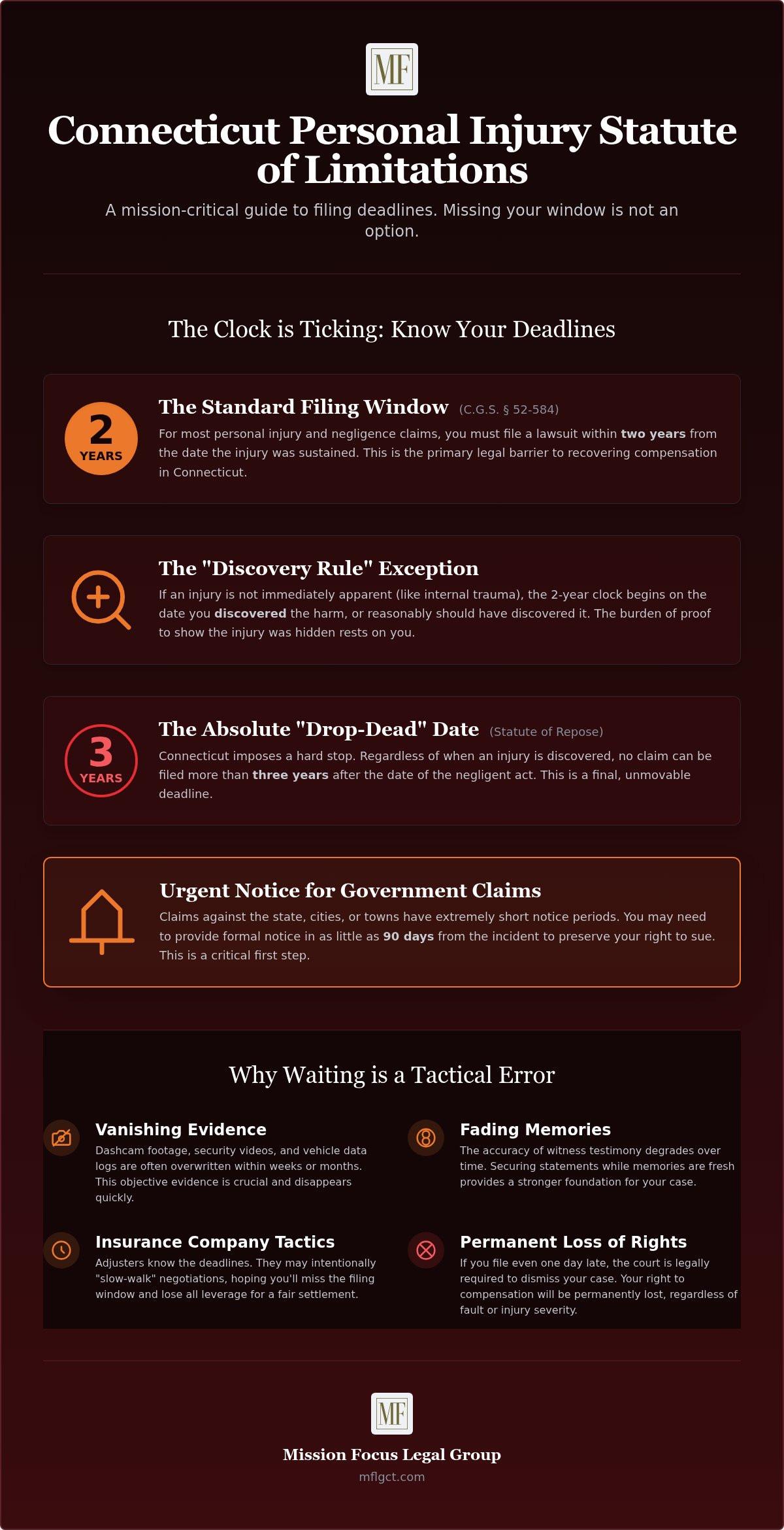
Under Connecticut General Statutes § 52-584, the baseline for filing a lawsuit is two years from the date the injury is sustained. This deadline, known as the statute of limitations, is a rigid boundary that requires immediate strategic planning. While some states allow three or four years for negligence claims, Connecticut’s tighter window demands a faster response from victims and their legal teams. We view this timeline as a mission-critical window where every day spent without a clear legal strategy is a day given to the opposition.
The clock technically starts when you suffer what the law calls actionable harm. This term refers to the moment you discover you’ve been injured and identify the causal link to another person’s negligence. In many cases, this is the day of the impact, but for internal or latent injuries, the timeline hinges on when a reasonable person should have recognized the damage. The two-year rule stands as the primary legal barrier to recovering compensation in Connecticut personal injury cases.
What Counts as the ‘Date of Injury’?
For most car, truck, or motorcycle accidents, the date of injury is the day of the collision. It’s the moment the physical trauma occurs and the harm becomes apparent. However, the legal clock doesn’t always start at the second of impact if the injury isn’t immediately obvious. We often look to the first medical report as a critical piece of evidence. This document establishes a professional record of your condition, providing a definitive anchor for the timeline. If you wait weeks to see a doctor, you risk the defense arguing that your actionable harm began earlier or was unrelated to the accident, which can compromise your standing in court.
Consequences of Missing the Two-Year Window
Missing this deadline is a catastrophic mission failure for your case. If you attempt to file even one day late, the court is legally obligated to dismiss your claim regardless of how severe your injuries are or how clear the defendant’s fault appears. Insurance adjusters are well aware of these dates. They often use slow-walk tactics, dragging out settlement negotiations to push you closer to the deadline. Their goal is to devalue your claim or wait until you lose your leverage entirely. Once the window closes, your right to seek maximum compensation is gone forever, leaving you to carry the financial burden of the accident alone.

Call For A Consultation
(860) 333-6455Exceptions and Extensions: When the Clock Stops Ticking
The law is strict, but it isn’t entirely inflexible. While the standard two-year window is the baseline for most claims, specific circumstances can pause or extend the clock. These exceptions to the Connecticut personal injury statute of limitations are narrow and require immediate legal verification to ensure your rights remain intact. Relying on a perceived extension without professional confirmation is a tactical risk that could end your claim before it begins. We also see tolling applied to minors, where the clock is often paused until the child reaches the age of majority, although parents should still act quickly to recover immediate medical costs.
The Discovery Rule in Connecticut
Injuries don’t always manifest the moment an accident occurs. Internal trauma or latent symptoms might take months to become apparent. The “Discovery Rule” allows the clock to start on the date you discovered the harm, or the date you reasonably should have discovered it. However, the burden of proof rests on you to show why the injury was hidden. Connecticut balances this with a “Statute of Repose,” which sets an absolute three-year limit from the date of the negligent act. If you discover harm after this three-year “drop-dead” date, your claim is likely barred regardless of when you found it.
Military Tolling and the SCRA
Active-duty service members face unique challenges that the law recognizes through the Servicemembers Civil Relief Act (SCRA). If you’re stationed at the Groton Sub Base or deployed abroad, your status can pause the statute of limitations. This “tolling” ensures that those serving their country aren’t penalized for being unable to access the court system while on duty. It provides a necessary shield for soldiers, sailors, and marines who are focused on their mission rather than a legal deadline.
Attorney Keith Anthony’s background as a U.S. Marine Corps Reserve Major provides him with a deep understanding of these military-specific protections. He knows the rhythm of service and how to leverage the SCRA to protect your interests. If you’re a service member or a dependent, a disciplined review of your timeline can help determine if your service has extended your window for filing. We approach every military case with the precision and reliability that your service deserves, ensuring no tactical advantage is lost due to deployment or relocation.

Call For A Consultation
(860) 333-6455Statute of Limitations by Case Type: A Strategic Breakdown
Precision is the hallmark of a successful legal strategy. While many believe every case follows a uniform timeline, the reality is that the Connecticut personal injury statute of limitations varies significantly based on the nature of the claim. A car accident in New Haven requires a different tactical approach than a wrongful death claim in Groton or a high-stakes truck accident involving complex logistics. Understanding these nuances is essential for protecting your right to maximum compensation.
While standard injury claims focus on a two-year window from the moment of harm, wrongful death actions shift the focus to a two-year window from the date of passing, capped by a five-year absolute limit from the original negligent act.
Car, Truck, and Motorcycle Accident Timelines
For typical traffic collisions, you generally have two years to file a lawsuit under the standard negligence rules. However, if the accident involves a vehicle owned by the State of Connecticut or a local municipality, the timeline accelerates dramatically. Claims against the state require a formal notice of claim filed with the Office of the Claims Commissioner within one year of discovery. Municipalities are even stricter; they often require written notice within 90 days for defective road or sidewalk claims, and six months for general employee negligence.
In truck accident cases, we prioritize immediate action because electronic logging device (ELD) data and digital logs are often overwritten or purged within 30 to 60 days. Waiting for the two-year legal deadline is a tactical error that allows critical “black box” evidence to vanish. Our team moves quickly to seize this data before the trucking company can legally destroy it. This disciplined approach ensures that we build your case on a foundation of hard evidence rather than fading memories.
Wrongful Death Claims in Connecticut
Losing a loved one is a profound tragedy that requires both empathy and a swift legal response. Under C.G.S. § 52-555, a wrongful death suit must be filed within two years of the date of death. This is distinct from the standard injury rule because the clock starts on the day of passing, not necessarily the day of the initial accident. However, the law imposes an absolute repose limit of five years from the date of the negligent act or omission that caused the death.
Only the executor or administrator of the deceased person’s estate has the legal standing to bring a wrongful death suit in Connecticut. This means the estate must be opened and a representative must be appointed before the litigation can proceed. We guide families through this process with a steady, calming presence, ensuring that the administrative requirements of the probate court don’t delay your pursuit of justice. Acting early allows us to secure witness testimony and forensic evidence while the details of the incident are still fresh.
The Risks of Delay: Why Waiting is a Tactical Error
While the Connecticut personal injury statute of limitations provides a two-year window for most claims, viewing this as a suggestion rather than an absolute deadline is a dangerous mistake. In the legal arena, time is a resource that either works for you or against you. Every day that passes after a collision is a day where critical evidence can be lost, altered, or destroyed. In the eyes of a defense attorney, tactical delay is the insurance company’s best friend. They want you to wait until your case is weakened by the simple passage of time and the erosion of physical proof.
Evidence degradation is a silent killer of even the strongest claims. Physical markers like skid marks on a New Haven street or debris patterns at a crash site in Groton wash away with the first rainstorm. Just as critical is the issue of witness memory fade. Over months of delay, the precise details of an accident become blurry, and a witness who was once certain of the facts may become hesitant under cross-examination. If you don’t move with disciplined urgency to preserve these assets, you’re essentially handing the opposition a tactical advantage they didn’t earn.
Evidence Preservation in High-Impact Accidents
Trucking companies often purge electronic logging device (ELD) data within weeks if a formal preservation letter isn’t issued by a legal professional. This “black box” data holds the key to proving driver fatigue, speeding, or mechanical failure. Similarly, surveillance footage from local businesses in high-traffic areas like New Haven or Mystic is often overwritten every 7 to 14 days. We act immediately to secure these recordings, ensuring that the objective truth of the accident is locked down before it’s deleted. For “invisible” injuries like concussions or soft tissue damage, immediate medical documentation is the only way to establish a clear link between the crash and your symptoms before the defense can claim your pain resulted from a different event.
Protecting Your Credibility
Waiting to seek treatment or legal advice creates a “gap in care” that insurance adjusters will exploit to devalue your claim. They’ll argue that if you were truly hurt, you wouldn’t have waited months to see a specialist or file a report. This undermines your credibility and makes your testimony appear coached rather than genuine. Without a battle-tested ally by your side, you might also inadvertently give a recorded statement to an adjuster that contradicts the facts of the case. Our team steps in from day one to handle all communications, protecting you from these common traps. You can secure your legal mission today by letting us take the lead on evidence seizure and witness interviews while the details are still fresh.
Secure Your Claim with Mission Focus Legal Group
Mission Focus Legal Group doesn’t just practice law; we execute a strategic plan designed to protect your future. Navigating the Connecticut personal injury statute of limitations requires more than just a calendar. It demands a battle-tested approach that anticipates defense maneuvers and secures critical evidence before it disappears. From the bustling streets of New Haven to the naval community in Groton and the historic neighborhoods of Norwich, we serve as a disciplined shield for those who have been wronged by negligence. We understand that your recovery depends on our precision.
Led by Keith Anthony, a U.S. Marine Corps Reserve Major with over 10 years of service in Connecticut, our firm operates with a level of reliability that traditional firms often lack. We treat every case as a mission where failure to meet a deadline is not an option. This military-grade discipline ensures that your filing is accurate, timely, and positioned for maximum impact. We don’t wait for the defense to make the first move. Instead, we initiate immediate evidence seizure and witness interviews to lock down the facts of your car, truck, or motorcycle accident while the trail is still warm.
The Keith Anthony Advantage
Attorney Keith Anthony brings the strategic advocacy of a JAG officer and the unflinching persistence of a Marine to every personal injury claim. This isn’t just about paperwork; it’s about protective confidence. We treat our clients with the same respect and loyalty we would show a fellow service member. While insurance giants rely on delay and confusion to devalue your claim, we counter with thorough preparation and a refusal to back down from high-stakes litigation. Our advocacy is persistent and thorough, ensuring that no tactical advantage is left on the table during negotiations or in the courtroom.
Contact Us for a Strategic Consultation
You shouldn’t have to carry the burden of legal deadlines while you’re trying to heal from a serious injury. We offer a no-cost, no-obligation review of your injury timeline to ensure you aren’t at risk of losing your rights under the law. Our team handles the heavy lifting, from filing notice requirements to managing complex discovery, allowing you to focus entirely on your physical recovery. We maintain clear and transparent communication throughout the process so you always know the exact status of your legal mission. Schedule your case evaluation with Mission Focus Legal Group today and let a battle-tested ally lead your fight for the compensation you deserve.
Take Command of Your Legal Timeline Today
The ticking clock is the greatest threat to your recovery after a serious accident. As we’ve explored, the Connecticut personal injury statute of limitations generally grants you a two-year window, but tactical delays and vanishing evidence can compromise your case long before that deadline arrives. Whether you’re dealing with the aftermath of a truck collision or a motorcycle crash, waiting to act is a risk you can’t afford.
Led by U.S. Marine Corps Reserve Major Keith Anthony, Mission Focus Legal Group provides the disciplined, high-stakes advocacy required to secure your rights across New Haven and New London Counties. We apply military-grade precision to every investigation, ensuring no detail is overlooked and no deadline is missed. You deserve a battle-tested ally who treats your case with the urgency it demands. Secure your rights and start your mission; contact Mission Focus Legal Group now. Your path to maximum compensation starts with a single, decisive step toward professional representation.
Frequently Asked Questions
What is the statute of limitations for a car accident in Connecticut?
In Connecticut, you generally have two years from the date of the collision to file a lawsuit for a car accident. This timeframe is established by C.G.S. § 52-584. Whether you’re in New Haven or Groton, the court will likely dismiss any claim filed after this window. Because evidence like skid marks and dashcam footage vanishes quickly, we recommend starting your legal mission as soon as possible to ensure your right to compensation is protected.
Can I still sue if I discovered my injury a year after the accident?
Yes, the “Discovery Rule” allows you to file within two years of when you discovered the injury, provided you couldn’t have known about it sooner. However, Connecticut imposes an absolute three-year statute of repose from the date of the negligent act. If you discover a hidden injury months later, you must act with extreme urgency. Proving that an injury was truly undiscoverable requires disciplined legal advocacy and thorough medical documentation to survive a defense challenge.
How long do I have to file a wrongful death claim in CT?
A wrongful death claim in Connecticut must be filed within two years of the date of death. This is governed by C.G.S. § 52-555. While the two-year window starts at death, the law also includes a five-year absolute limit from the date of the underlying negligent act. If your loved one passed away in Norwich or Mystic due to a previous injury, these overlapping deadlines make immediate consultation with a battle-tested legal ally essential.
Does the statute of limitations change if the accident involved a city bus or government vehicle?
Yes, claims involving government vehicles or public property have much shorter notice requirements. For accidents involving the State of Connecticut, you must file a notice of claim within one year. If you’re injured by a municipal bus or a defective sidewalk in West Haven or Milford, you may have as little as 90 days to provide written notice. Missing these specialized windows can bar your claim before the standard Connecticut personal injury statute of limitations even begins.
What happens if the 2-year deadline falls on a weekend or holiday in Connecticut?
If your filing deadline falls on a Saturday, Sunday, or a legal holiday, Connecticut law typically allows you to file on the next business day. However, treating this as a safety net is a tactical error. We prioritize filing well ahead of the deadline to avoid technical failures or administrative delays. Our team operates with the discipline of a military unit to ensure your case is securely lodged with the court long before the final hour arrives.
Is there an exception for injuries to children in Connecticut?
Connecticut law often pauses, or “tolls,” the statute of limitations for minors until they reach the age of 18. This gives children injured in accidents in North Branford or Ledyard more time to seek justice. However, parents should still file promptly. Recovering immediate medical costs and preserving evidence from the crash site is much harder if you wait years. We help families secure their claims early while the mission-critical facts are still fresh and verifiable.
How does being on active military duty affect my personal injury deadline?
The Servicemembers Civil Relief Act (SCRA) can pause the legal clock while you’re on active duty. If you’re stationed at the Groton Sub Base or deployed abroad, this protection ensures your service doesn’t cost you your right to sue. Attorney Keith Anthony uses his experience as a Marine Corps Reserve Major to navigate these specific military tolling rules. We ensure that those protecting our country receive the same high-stakes advocacy and protective confidence they provide to us.
What should I do if my injury happened 23 months ago and I haven’t filed yet?
You must contact a legal professional immediately to initiate an emergency filing. With only one month remaining, there is no room for hesitation or administrative mistakes. Our team can move quickly to secure a Connecticut personal injury statute of limitations extension or file the necessary paperwork to stop the clock. We handle the heavy lifting of evidence seizure and witness identification under high-pressure conditions, allowing you to focus on your recovery while we secure the mission.
Call For A Consultation
(860) 333-6455