
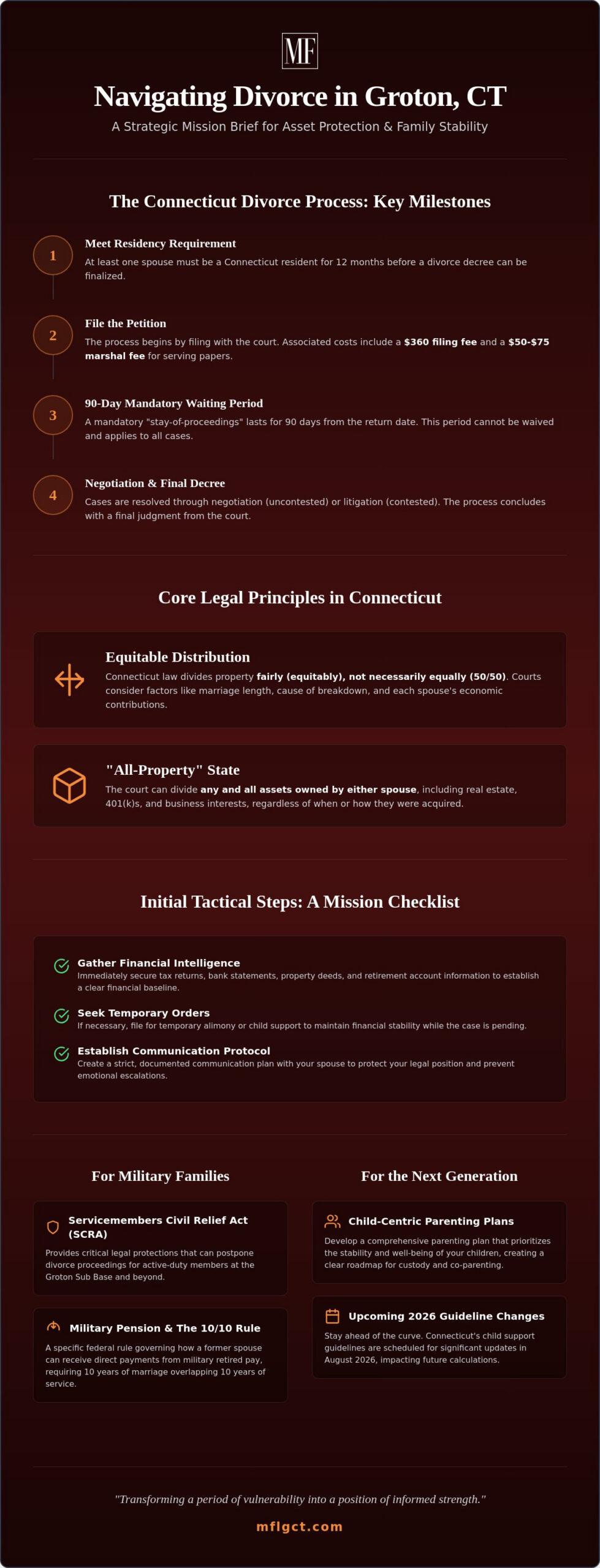
In a town defined by the precision of the Sub Base, a divorce shouldn’t be a chaotic retreat; it should be a calculated mission to protect what you’ve built. Finding a divorce attorney Groton CT who understands the high stakes of your specific situation is the first step toward regaining control. You’re likely feeling the weight of uncertainty regarding your assets and the stability of your children’s future, and that’s a burden no one should carry without a battle-tested ally by their side.
We’re here to ensure your future is secured through mission-driven legal strategies tailored specifically for Groton residents and our local military families. This guide explores how to navigate the August 2026 updates to Connecticut’s child support guidelines, the complexities of equitable property division, and the path toward a stable custody arrangement. You’ll learn how a disciplined, strategic approach can transform a period of vulnerability into a position of informed strength, providing the clear communication and protective advocacy you deserve.
A high-stakes divorce is not just a legal process; it’s a tactical mission where your future security depends entirely on the strength of your initial strategy. You likely recognize that the decisions made today will echo for years, affecting everything from your retirement accounts to your relationship with your children. This guide provides the strategic intelligence you need to secure your future, offering mission-driven legal strategies tailored for Groton residents and military families. We’ll explore the complexities of Connecticut’s “All-Property” equitable distribution laws and the specific factors courts use to determine alimony awards, including the 2026 child support updates.
You’ll also learn how to develop a parenting plan that stabilizes child custody and understand the critical protections for service members at the Groton Sub Base. Choosing a divorce attorney Groton CT with military-grade discipline ensures your assets are protected and your voice is heard. We’ll preview the essential steps for navigating the 10/10 rule for pensions and the Servicemembers Civil Relief Act, providing a clear path from uncertainty to informed strength. This overview ensures you’re prepared for every phase of the legal process with a battle-tested ally by your side.

Call For A Consultation
(860) 333-6455Navigating Divorce in Groton, CT: A Mission-First Approach
Divorce in Connecticut is more than a legal filing; it’s a tactical transition that requires a clear objective from the start. For those seeking a divorce attorney Groton CT, the “Mission-First” philosophy is the foundation of a successful outcome. This approach demands that we identify your primary goals, whether they involve asset protection, child stability, or long-term financial independence, before initiating the process. By defining the “end-state” early, every legal maneuver becomes a purposeful step toward your specific target rather than a reactive response to conflict.
Connecticut operates under the principle of equitable distribution. Unlike community property states, Connecticut courts divide marital property based on what is fair, which isn’t always a simple 50/50 split. This falls under the broader framework of Divorce in the United States, where state-specific nuances dictate the division of everything from real estate to retirement accounts. To file in the Groton area, at least one spouse must meet the 12-month residency requirement before the decree is finalized. The process begins with a $360 filing fee and the service of process, usually handled by a state marshal for a fee between $50 and $75.
The path you take depends on whether the divorce is contested or uncontested. An uncontested divorce occurs when both parties agree on all terms, including property division and custody. However, if any disagreement exists, the case is considered contested. Most high-stakes cases begin as contested matters, requiring a divorce attorney Groton CT who can pivot between aggressive litigation and strategic negotiation as the mission evolves. This flexibility ensures that your interests are protected even if the opposition becomes entrenched.
The Legal Landscape of New London County
Cases in Groton are typically handled at the New London Superior Court. It’s vital to understand the mandatory 90-day waiting period, known as a stay-of-proceedings. This period begins on the “return date” and cannot be waived. Local representation is critical because each court has its own rhythm and procedural nuances. A battle-tested ally who understands the local bench can provide the steady, calming presence you need when explaining these complex timelines and requirements.
Initial Tactical Steps
Success in family law requires superior intelligence gathering. You must secure tax returns, bank statements, and property deeds immediately to establish a clear financial baseline. While the case is pending, we often seek temporary orders for alimony or child support to maintain your stability. Establishing a strict communication protocol with your spouse is equally important; it protects your rights and prevents emotional outbursts from compromising your legal position from day one.
Strategic Asset Protection: Property and Alimony in CT
Securing your financial perimeter is the highest priority in a high-stakes divorce. In Connecticut, asset division follows an “All-Property” model of equitable distribution. This means the court has the authority to assign to either spouse all or any part of the estate of the other, regardless of when or how the asset was acquired. For residents seeking a divorce attorney Groton CT, this requires a rigorous defensive strategy to protect real estate, 401(k) retirement accounts, and closely held business interests that define your financial stability.
The court doesn’t just look at account balances. Judges evaluate the length of the marriage, the cause of the breakdown, and the total economic contribution of each party. If you have a prenuptial or postnuptial agreement in place, these documents serve as pre-established mission parameters that can significantly streamline the litigation process. Without them, every asset becomes a potential point of contention that requires a disciplined, evidence-based approach to resolve. You can review the specific forms and procedural requirements for these filings through the Connecticut Judicial Branch website.
Equitable vs. Equal Distribution
It’s a common misconception that assets are always split 50/50. In Connecticut, “equitable” means fair, not necessarily equal. Judges use a specific set of criteria to divide the marital estate, including the age, health, station, and earning capacity of each spouse. While Connecticut is a no-fault state for the purpose of filing, the “cause of the dissolution” can still influence how a judge decides to distribute property. A battle-tested advocate will ensure the court sees the full context of your contributions to the marriage.
Alimony Strategy and Duration
Alimony is not determined by a fixed formula; it’s decided on a case-by-case basis under C.G.S. § 46b-82. We categorize spousal support into three primary tactical phases:
- Pendente Lite: Temporary support provided while the divorce is active.
- Rehabilitative: Time-limited support designed to allow a spouse to become self-sufficient.
- Permanent: Reserved for long-term marriages where a significant disparity in age or health exists.
We often negotiate the tactical use of lump-sum alimony versus monthly payments to provide our clients with a cleaner break and greater long-term financial certainty. If you’re concerned about how these factors will impact your specific estate, it’s time to consult with a strategic legal ally who understands the high stakes involved.

Call For A Consultation
(860) 333-6455Protecting the Next Generation: Child Custody and Support
Your children represent the most critical objective in any dissolution. In New London County, the court’s primary directive is the “Best Interests of the Child” standard, a multi-factored evaluation that prioritizes stability and safety. Securing this future requires more than just a template; it demands a strategic blueprint. Working with a divorce attorney Groton CT ensures that your parental rights are defended with the same discipline used to protect your financial assets. We move through this phase of the mission with tactical clarity, ensuring no detail regarding your children’s well-being is left to chance.
The process of securing your children’s future follows five essential steps. First, we must distinguish between legal and physical custody. Legal custody involves the authority to make major life decisions, while physical custody dictates where the child resides. Second, we develop a comprehensive parenting plan. This document must be precise to minimize future conflict, covering everything from holiday rotations to daily transitions. Third, we calculate support. As of August 1, 2026, the updated Connecticut Child Support and Arrearage Guidelines now cover net incomes up to $6,000 per week, reflecting a significant increase in the calculation schedule. Fourth, we address specialized needs such as private school tuition or extracurricular costs. Finally, we finalize these orders through mediation or, if necessary, decisive court intervention. You can find detailed resources on these procedures through the Connecticut Judicial Branch family law portal.
Joint Legal Custody in Connecticut
In most cases, Connecticut courts favor joint legal custody. This arrangement requires parents to share decision-making responsibilities for the child’s health, education, and religious upbringing. It’s a collaborative effort that demands clear communication protocols. For a deeper dive into how these decisions are structured, see our guide on Understanding Joint Legal Custody in Connecticut. In high-conflict scenarios, we may advocate for “tie-breaking” authority on specific issues to prevent legal gridlock from stalling your child’s development.
The Role of the Guardian Ad Litem (GAL)
When custody disputes become complex, the court often appoints a Guardian Ad Litem (GAL). This individual is an attorney or mental health professional tasked with representing the child’s best interests independently of either parent’s wishes. Preparing for a GAL’s home visits and interviews requires meticulous preparation. Their recommendations carry significant weight with the judge and often form the backbone of the final custody decree. Additionally, remember that both parents must complete a mandatory parenting education program, which carries a $125 fee per person, before the divorce can be finalized.

Call For A Consultation
(860) 333-6455The Military Factor: Divorce Near the Groton Sub Base
Living and serving near the Naval Submarine Base New London creates a unique legal environment where federal regulations often overlap with Connecticut state statutes. For anyone searching for a divorce attorney Groton CT, understanding these intersections is vital for a successful outcome. Military divorce involves specific protections like the Servicemembers Civil Relief Act (SCRA). This federal law provides a stay of proceedings for those on active duty, ensuring that your service to the country doesn’t result in a tactical disadvantage or a default judgment in the courtroom.
The division of military retirement is another high-stakes area governed by the Uniformed Services Former Spouses’ Protection Act (USFSPA). We pay close attention to the “10/10 Rule,” which requires at least ten years of marriage overlapping ten years of creditable service for the non-service member spouse to receive direct payments from DFAS. Additionally, child support and alimony calculations must account for Basic Allowance for Housing (BAH) and Basic Allowance for Subsistence (BAS). While these are non-taxable allowances, Connecticut courts treat them as income for support purposes, making accurate calculation essential for a fair financial decree.
Parenting plans in military families must be exceptionally robust. We incorporate specific “contingency operations” clauses to address deployments, temporary duty assignments, and Permanent Change of Station (PCS) orders. These provisions ensure that your relationship with your children remains stable, regardless of where the mission takes you. It’s about building a plan that accounts for the reality of service life rather than relying on standard templates that fail under the pressure of military orders.
Strategic Defense for Service Members
Leveraging Keith Anthony’s experience as a U.S. Marine Corps Reserve Major and former Judge Advocate, we provide a defense that understands the internal pressures of military life. A divorce isn’t just a personal matter; it can impact security clearances and your professional standing within the chain of command. We act as a disciplined protector of your career and your rights. If you’re facing these challenges, you need a Military Family Law Attorney who speaks the language of the service and understands the high stakes of your position.
Support for Military Spouses
Military spouses face their own set of unique challenges, often living far from extended family support networks during a time of crisis. We ensure you maintain fair access to critical benefits like TRICARE and base privileges when eligible under the 20/20/20 or 20/20/15 rules. Securing a portion of the military retirement fund is often the most significant asset in these cases. We treat this as a mission-critical objective to ensure your long-term stability. If you’re ready to secure your future, contact our team for a strategic consultation.
Securing Your Future: Why Mission Focus Legal Group is Your Ally
You’ve worked too hard to let a legal oversight compromise your future. Choosing the right legal partner is the most consequential decision of your divorce mission. While other firms might offer standard representation, we provide a disciplined framework designed to move you from a state of vulnerability to a position of informed strength. As your divorce attorney Groton CT, we don’t just file paperwork; we execute a strategy that anticipates challenges before they arise, ensuring your assets and parental rights remain secure.
Our commitment to you is rooted in clear communication and mission-driven results. We understand that the legal process can feel overwhelming, especially when high-stakes assets or military benefits are on the line. That’s why we prioritize a steady, calming presence during consultations while maintaining a formidable stance in the courtroom. We don’t believe in passive observation. We are your bold advocates, persistent in our pursuit of a fair property division and a stable parenting environment for your family.
The Keith Anthony Difference
Success in family law requires a calculated blend of military-grade discipline and compassionate advocacy. Keith Anthony brings his experience as a U.S. Marine Corps Reserve Major and former Judge Advocate to every case he handles. This background provides a level of tactical foresight that is rare in traditional legal circles. For over 10 years, we’ve served the New London County community, building a track record of stability and persistence. We focus on protecting your long-term interests, ensuring that the decree you sign today doesn’t become a liability five years down the road.
Take the First Step Toward Resolution
The path to a new beginning starts with a single, decisive action. Preparing for your initial meeting is simple but critical. We recommend gathering the financial intelligence mentioned earlier in this guide, such as tax returns and property deeds, to help us establish your financial perimeter immediately. When you visit our Groton-area office, you’ll find a team that listens with empathy but plans with the precision of a military operation. We’ll walk you through the specifics of your case, from the 90-day waiting period to the complexities of military pension division.
Don’t leave your future to chance or settle for a counselor who lacks a strategic methodology. You deserve a partner who is both a fierce presence in litigation and a reliable guide in private consultation. It’s time to take control of your narrative and secure the outcome your family needs. Schedule your consultation with a Groton divorce attorney today.
Take Command of Your Legal Transition
Your divorce shouldn’t be defined by chaos; it should be defined by the strategy you use to resolve it. We’ve explored how a mission-first approach protects your assets, stabilizes your children’s future, and navigates the unique intersection of military and state law. Whether you’re dealing with the complexities of the Groton Sub Base or high-stakes property division, the right guidance turns uncertainty into a position of strength. Securing your future requires a disciplined advocate who understands that every decision made today impacts your long-term stability.
Partnering with a divorce attorney Groton CT ensures your interests are guarded by a battle-tested ally. Led by Major Keith Anthony, USMCR, our firm brings over 10 years of Connecticut legal experience and specialized knowledge of military family law to your side. We remain committed to clear communication and unflinching advocacy for every resident we serve. You deserve a legal partner who is as formidable to adversaries as they are supportive to you.
Don’t wait for the situation to dictate your terms. Contact Mission Focus Legal Group for a Strategic Consultation and start building your path forward today. You have the strength to navigate this transition, and we have the discipline to lead the way.
Frequently Asked Questions
How long does a divorce take in Groton, Connecticut?
A divorce in Connecticut takes a minimum of 90 days due to the mandatory stay-of-proceedings. While uncontested cases may resolve shortly after this period, contested matters involving high-stakes assets or custody disputes often take 12 to 18 months to reach a final decree. The total duration depends on the complexity of your financial estate and the ability of both parties to reach a strategic agreement through negotiation or trial.
How much does a divorce attorney in Groton CT cost?
The total investment for a divorce attorney Groton CT varies based on the intensity of the litigation and the complexity of the assets involved. Factors such as the need for forensic accountants, child custody evaluators, or business valuation experts impact the resources required for your case. A highly contested trial requires more tactical preparation than a mediated settlement. We focus on providing disciplined, efficient advocacy to ensure every action taken serves your primary mission.
What is the “90-day cooling-off period” in CT divorce law?
The “90-day cooling-off period” is a mandatory waiting period required by Connecticut law before a judge can grant a divorce decree. This period begins on the “return date” listed on your initial filing paperwork. It serves as a stay-of-proceedings, allowing parties to settle temporary motions regarding support or custody. While it cannot be waived, we use this time to gather financial intelligence and build a robust case for the final hearing.
Can I get a divorce if my spouse is currently deployed from the Groton Sub Base?
You can initiate a divorce while a spouse is deployed, but the Servicemembers Civil Relief Act (SCRA) provides specific protections that may pause the timeline. The SCRA allows an active-duty service member to request a stay of proceedings for at least 90 days if their duties prevent them from appearing in court. We navigate these federal requirements with precision to ensure your case moves forward without violating the legal rights of the deployed service member.
How is property divided if it was owned before the marriage in CT?
Connecticut is an “all-property” equitable distribution state, meaning the court has the authority to divide all assets regardless of when they were acquired. Property owned before the marriage is not automatically exempt from division. However, the court considers the contribution of each party in the acquisition, preservation, or appreciation in value of their respective estates. We work to protect your pre-marital assets by documenting their origins and current valuations for the court.
What happens if we can’t agree on a child custody schedule?
If you cannot agree on a custody schedule, the court will intervene to determine an arrangement based on the best interests of the child. This process often involves mandatory mediation, the appointment of a Guardian Ad Litem, or a formal custody evaluation by court-appointed experts. Our role is to present a clear, evidence-based parenting plan that demonstrates your commitment to the child’s stability while advocating for your parental rights in the New London Superior Court.
Do I have to go to court for a divorce in New London County?
Most divorces in New London County require at least one court appearance to finalize the decree, even in uncontested cases. For contested matters, you may need to attend several hearings for temporary orders or pre-trial conferences. While some procedural meetings now occur remotely, high-stakes trials are typically held in person. We handle the logistical heavy lifting, ensuring you’re prepared for every appearance and that your presence in court projects confidence and clarity.
Is Connecticut a “no-fault” divorce state?
Connecticut is a no-fault state, meaning you only need to testify that the marriage has broken down irretrievably with no hope of reconciliation. You don’t need to prove adultery or cruelty to obtain a decree. However, the “cause of the breakdown” is a statutory factor that judges consider when deciding alimony and property division. If a spouse’s actions led to the end of the marriage, that evidence becomes a tactical component of your financial strategy.
Call For A Consultation
(860) 333-6455