
In the high-stakes theater of family law, a Connecticut divorce isn’t just a legal filing; it’s a mission where your financial security and your children’s stability are the primary objectives. You’re likely feeling the weight of the state’s “no-fault” system and worrying if “equitable distribution” truly means you’ll keep what you’ve worked for. It’s natural to feel anxious when the roadmap ahead seems clouded by updated child support guidelines and strict residency requirements. You deserve a partner who views your case with the same urgency and precision you do.
By partnering with a disciplined divorce lawyer Connecticut families rely on for strategic advocacy, you can replace that uncertainty with a clear, tactical plan. We’ll help you navigate the complexities of the legal system to secure a fair asset division and a stable custody arrangement that protects your future. This article previews the essential steps of the legal process, explains the mandatory 90-day waiting period, and details the specific protections available for military families under federal law. You’ll gain the clarity needed to move from a position of vulnerability to one of informed strength.
Key Takeaways
- Understand the 12-month residency requirement and the legal framework of “marital dissolution” to ensure your filing stands on solid ground.
- Learn how Connecticut’s “Equitable Distribution” standard differs from community property and what it means for your high-value assets.
- Discover the “Best Interests of the Child” standard and the critical differences between legal and physical custody for your future parenting plan.
- Partner with a divorce lawyer Connecticut service members trust to navigate the unique complexities of the SCRA and military pension division.
- Establish a tactical roadmap for your legal proceedings through a mission-focused strategy that prioritizes clear objectives and thorough case preparation.

Call For A Consultation
(860) 333-6455Table of Contents
- Understanding Connecticut Divorce Law: The Basics of Marital Dissolution
- Strategic Asset Division: Protecting Your Financial Mission
- Child Custody and Support: Securing the Next Generation
- The Military Divorce Advantage: Specialized Advocacy for Service Members
- Navigating the Legal Roadmap with Mission Focus Legal Group
Understanding Connecticut Divorce Law: The Basics of Marital Dissolution
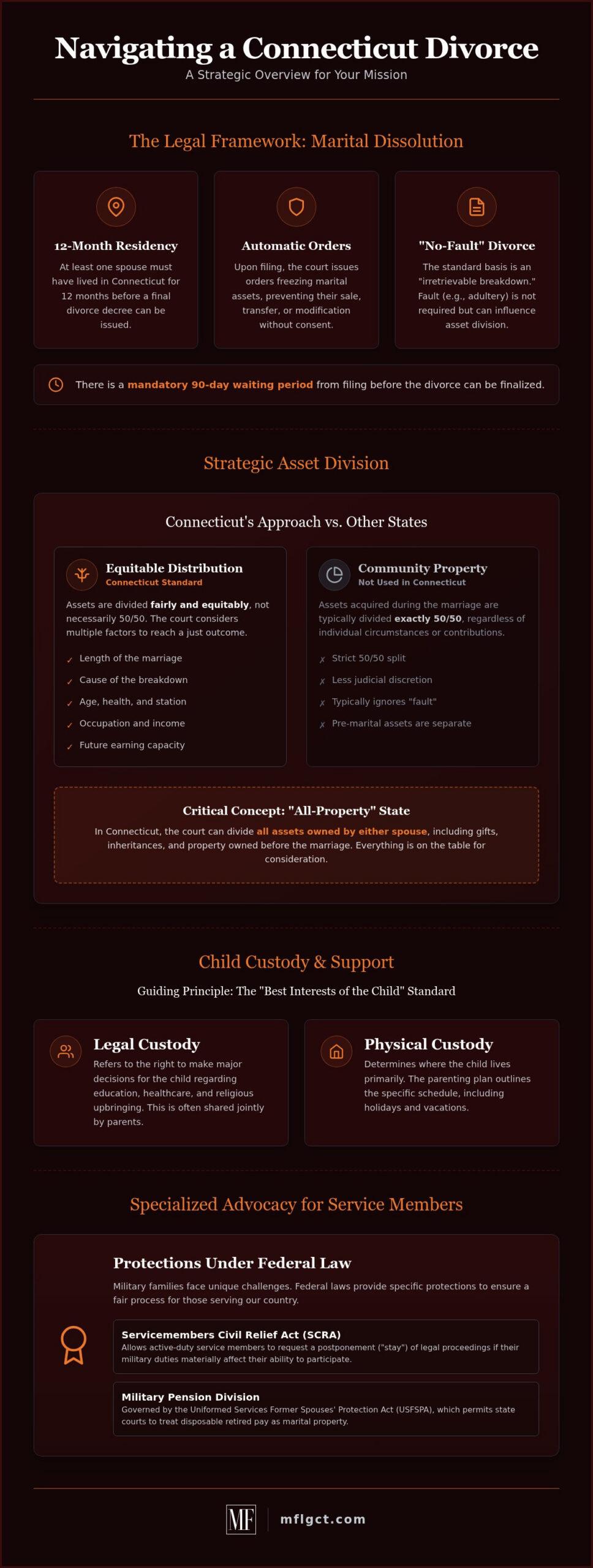
In the Connecticut Superior Court system, the technical term for ending a marriage is “marital dissolution.” It’s a formal legal process that requires more than just a desire to separate; it demands a tactical understanding of state statutes. When you first file, the court issues “automatic orders” that immediately freeze marital assets, preventing either spouse from hiding funds, selling property, or changing insurance policies without consent. This is your first line of defense. A skilled divorce lawyer Connecticut relies on will ensure these protections are strictly enforced from day one to maintain your financial baseline.
Connecticut operates under a “no-fault” standard. You don’t have to prove your spouse committed a specific wrong to end the marriage. Instead, you simply state the relationship has “broken down irretrievably.” While Divorce in the United States varies significantly by jurisdiction, Connecticut’s approach is designed to reduce initial conflict while still allowing the court to examine conduct later during asset division. This system prioritizes the efficient resolution of the legal contract of marriage.
Residency Requirements and Filing Jurisdictions
To finalize your dissolution, at least one spouse must have resided in Connecticut for 12 months. You can file before reaching this milestone, but the court won’t enter a final decree until the clock hits one year. If you live in Groton or Waterford, your case will typically proceed through the New London judicial district. Residents in New Haven follow a different path through their local district court. There are exceptions to the one-year rule, such as if a spouse was domiciled in the state at the time of the marriage and returned with the intent to stay permanently.
The “No-Fault” vs. Fault-Based Divorce Debate
Choosing “no-fault” is the standard tactical move for most families. It’s faster and avoids the high-conflict evidentiary requirements of proving specific misconduct. However, “fault” isn’t entirely irrelevant to your strategy. Judges in Connecticut have broad discretion when dividing property. If misconduct like adultery or financial waste led to the marriage’s end, a judge may factor that behavior into alimony awards or asset distribution. An experienced divorce lawyer Connecticut trusts will analyze the “cause of the breakdown” as part of the initial intelligence gathering to determine how it might impact your specific financial mission.

Call For A Consultation
(860) 333-6455Strategic Asset Division: Protecting Your Financial Mission
Asset division in Connecticut is not a simple 50/50 split. It’s a calculated process of “equitable distribution” where fairness overrides a rigid mathematical formula. Unlike community property states where assets are sliced down the middle, Connecticut judges aim for equity based on a specific set of variables. They weigh the length of the marriage, the primary cause of the breakdown, and each spouse’s future earning capacity. To secure your financial baseline, you need a divorce lawyer Connecticut residents trust to present these variables with precision and authority.
Transparency is the bedrock of a successful mission. The Connecticut Judicial Branch Family Division requires full financial disclosure from both parties through mandatory sworn affidavits. Hiding assets or obscuring income isn’t just unethical; it’s a tactical failure that can lead to severe court sanctions and a total loss of credibility. We utilize disciplined discovery processes to uncover the true scope of the marital estate. This rigorous approach ensures that the intelligence we gather is accurate and that no hidden accounts or undervalued properties undermine your future stability.
Classifying Marital vs. Non-Marital Property
Connecticut is an “all-property” state. This unique legal framework means the court has the authority to assign to either spouse all or any part of the estate of the other, regardless of when it was acquired. This includes gifts, inheritances, and assets owned long before the wedding. While other states shield pre-marital property, Connecticut puts everything on the table for consideration. “The value of an asset is a snapshot in time, but its distribution is a roadmap for your future.” We focus on protecting what you brought into the marriage while ensuring you receive a fair share of the wealth built during the partnership.
Evaluating High-Stakes Assets and Business Interests
High-stakes assets require specialized intelligence. Dividing retirement accounts like 401(k)s or pensions often involves Qualified Domestic Relations Orders (QDROs) to avoid immediate tax penalties. For business owners, a professional valuation is essential to protect the integrity of the practice or company. A veteran divorce lawyer Connecticut families choose will also analyze the family home against the current market to determine if a buy-out or sale serves your long-term objectives. If you’re concerned about protecting complex holdings, it’s time to consult with a strategic advocate who understands the nuances of high-stakes financial litigation.

Call For A Consultation
(860) 333-6455Child Custody and Support: Securing the Next Generation
Protecting your children is the highest priority of any legal mission. In the Connecticut court system, every decision regarding your family’s future is governed by the “Best Interests of the Child” standard. This isn’t a vague sentiment; it’s a mandatory legal framework that judges use to evaluate everything from parental stability to the child’s existing relationships. A divorce lawyer Connecticut parents trust will help you distinguish between legal custody, which covers major life decisions like medical care and education, and physical custody, which dictates where your child resides. To understand the broader context of these regulations, resources like Connecticut Divorce Laws provide a baseline for how the state manages these sensitive transitions. In high-conflict scenarios, the court may appoint a Guardian ad Litem (GAL) or an Attorney for the Minor Child (AMC) to act as an independent voice for your children’s welfare.
Developing a Disciplined Parenting Plan
A successful parenting plan functions like a tactical operations order. It must be precise, predictable, and resilient to minimize future conflict. For families in New Haven county, this means accounting for the logistical realities of coastal commuting and specific school district boundaries. We design mission-ready schedules that cover holiday rotations, spring breaks, and summer vacations with absolute clarity. If life changes significantly after the final decree, such as a job relocation or a shift in a child’s medical needs, we pursue formal modifications to ensure the parenting plan remains effective and relevant.
Child Support Calculations and Deviations
Connecticut utilizes an income-shares model based on the combined net weekly income of both parents. This system assumes that children should receive the same proportion of parental income they would have if the parents lived together. As of August 1, 2026, major revisions to the Connecticut Child Support and Arrearage Guidelines went into effect, expanding the income schedule to cover net weekly incomes up to $6,000. While the basic math is standardized, judges can deviate from these figures for several reasons:
- Special educational or medical needs of the child.
- Significant disparity in parental income.
- Coordination of total family support, including alimony.
- Specific extracurricular costs like competitive sports or tutoring.
We ensure that health insurance premiums and these additional expenses are properly allocated so your children’s standard of living remains secure. Your divorce lawyer Connecticut advocate will fight for a support order that reflects the actual financial requirements of your next generation’s future.
The Military Divorce Advantage: Specialized Advocacy for Service Members
Military service demands a unique level of sacrifice, and the legal system recognizes this through specific federal protections. When a service member or their spouse files for divorce, the case moves beyond standard state statutes into the territory of federal regulations. A divorce lawyer Connecticut military families rely on must have a deep understanding of the Servicemembers Civil Relief Act (SCRA) to prevent unfair default judgments during deployments. At Mission Focus Legal Group, we bring a veteran-led perspective to these cases. Attorney Keith Anthony’s background as a Marine Corps Judge Advocate and current Reserve Major provides the tactical intelligence required to protect your career and your benefits.
The division of military retired pay is governed by the Uniformed Services Former Spouses’ Protection Act (USFSPA). This is fundamentally different from the civilian 401(k) division mentioned earlier. For families stationed at the Groton Sub Base, these assets often represent the most significant portion of the marital estate. We understand the nuances of these federal regulations, ensuring that the division of benefits is handled with the same discipline you bring to your service.
Navigating Deployment and Custody
Deployment shouldn’t be a liability in family court. Connecticut law and the SCRA provide safeguards against permanent custody changes while a parent is serving overseas. We specialize in drafting parenting plans that account for the reality of Permanent Change of Station (PCS) moves and long-distance visitation. By leveraging Keith Anthony’s JAG experience, we build a strategic defense that prioritizes your parental rights. This ensures your relationship with your children remains intact, regardless of where the mission takes you or how often your duty station changes.
Military Benefits and Alimony
Financial support in a military context requires a specialized lens. The 10/10 rule is a critical threshold; if the marriage lasted at least 10 years and overlapped with 10 years of service, the non-military spouse may receive their portion of the pension directly from the Defense Finance and Accounting Service (DFAS). We also navigate the 20/20/20 rule, which allows a former spouse to retain full military benefits, including healthcare, if the marriage and service overlapped for two decades. Additionally, we must factor in Basic Allowance for Housing (BAH) and other allowances when calculating support obligations in Connecticut. This non-taxable income can significantly shift the income-shares model. To ensure your benefits are calculated with absolute accuracy, schedule a military law defense consultation today to begin your strategic planning.
Navigating the Legal Roadmap with Mission Focus Legal Group
Every successful legal operation begins with a comprehensive briefing. During your initial consultation, we define the mission, identify key objectives, and establish a baseline for your future. This isn’t just about filling out paperwork; it’s about understanding your specific priorities and the unique dynamics of your family. A divorce lawyer Connecticut families trust will use this time to assess the strengths and vulnerabilities of your position. From there, we move into the discovery phase, which is essentially gathering intelligence. We leave no stone unturned, ensuring every bank statement, tax return, and property valuation is verified and analyzed. This preparation allows us to build a strategy that is proactive rather than reactive, keeping you one step ahead throughout the proceedings.
Choosing the right battlefield is a critical strategic decision that impacts the timeline and cost of your case. Mediation often provides a more controlled environment where both parties can reach a settlement without a judge’s direct intervention. It’s often faster and preserves more of the marital estate for your family’s use. However, when an adversary is uncompromising or assets are being hidden, litigation becomes the necessary theater of operations. We are battle-tested in Connecticut courtrooms and won’t hesitate to fight for your interests when a fair agreement isn’t on the table. Finalizing the decree is the final objective, ensuring a stable and secure transition to your new life.
Why a Disciplined Strategy Matters
A lack of direction is the fastest way to drain your financial resources. Without a disciplined strategy, cases often spiral into protracted, expensive litigation over minor details that don’t serve your long-term mission. Clear communication between you and your advocate reduces the emotional weight of the process and keeps the focus on the primary goal. If your family’s situation involves complex needs for your children, such as special education advocacy or student rights, our firm can provide integrated support. You may find additional value in consulting an Education Law Attorney Connecticut to ensure your child’s academic future is protected during the custody transition.
Your First Steps Toward Resolution
The first 30 days of a divorce filing are critical for establishing momentum and protecting your rights. You can seize the initiative by immediately gathering essential financial documents, including three years of tax returns, the last six months of bank statements, and current retirement account balances. Prioritizing your goals is equally vital. Determine what is non-negotiable, whether it’s the family home, a specific parenting schedule, or the protection of a business interest. Contacting Keith Anthony to begin your strategic defense is the final step in taking control of your situation. We stand ready to serve as your disciplined protector through every phase of this mission, providing the steady guidance you need to move forward with confidence.
Secure Your Future with a Disciplined Legal Strategy
Navigating a dissolution of marriage in Connecticut is a significant operation that requires precision and persistence. You’ve seen how equitable distribution can impact your financial mission and why a specialized approach is vital for military families stationed in the Groton area. Moving forward with a clear roadmap ensures that your assets are protected and your children’s best interests remain the primary objective. Transitioning from a state of uncertainty to one of tactical strength begins with choosing an advocate who understands the weight of your burden.
Mission Focus Legal Group brings a unique advantage to your case. Led by a former Marine Corps Judge Advocate with over a decade of high-stakes legal advocacy in CT, we provide dedicated family law representation from Groton to New Haven. It’s time to replace anxiety with a focused plan of action. Schedule Your Strategic Divorce Consultation with Keith Anthony to begin your defense. Let a divorce lawyer Connecticut families trust as a disciplined protector guide you through this complex landscape. You’ve worked hard for your future, and we’re here to help you secure it.
Frequently Asked Questions
How long does a divorce take in Connecticut?
A typical Connecticut divorce takes a minimum of 90 days, though complex or contested cases often last a year or longer. You must meet the 12-month residency requirement before the court enters a final decree. Factors like property disputes or custody disagreements act as variables that extend the timeline. We focus on maintaining a steady momentum to resolve your mission as efficiently as possible while ensuring no tactical details are overlooked.
What is the “90-day waiting period” in CT divorce?
Connecticut law mandates a 90-day waiting period, often called a “cooling-off” period, which begins after the return date of the divorce complaint. You cannot receive a final judgment before this window closes. This period is a strategic time for discovery and negotiation. It allows both parties to organize their financial intelligence and develop parenting plans before the court takes final action on the dissolution of the marriage contract.
Can I get alimony if the divorce was my spouse’s fault?
You can receive alimony even in a no-fault system, and a spouse’s misconduct can influence the court’s final decision. While “irretrievable breakdown” is the standard filing ground, judges have the discretion to consider the “cause of the breakdown” when determining the amount and duration of support. A divorce lawyer Connecticut trusts will highlight these facts during litigation to ensure the final award reflects the reality of your specific situation and future needs.
Is Connecticut a 50/50 state for property division?
Connecticut isn’t a 50/50 community property state; it follows the “equitable distribution” model. This means the court divides marital property fairly, which doesn’t always result in an equal split. Judges evaluate the length of the marriage, each spouse’s earning capacity, and their respective contributions to the marital estate. We use a disciplined approach to argue for a distribution that protects your financial baseline and recognizes your long-term stability requirements.
What happens to the house in a Connecticut divorce?
The family home is often the most significant asset in a marital estate and can be handled in several ways. The court might order the property sold and the proceeds split, or one spouse may buy out the other’s interest. In cases involving minor children, a judge might allow a deferred sale to maintain the child’s stability. We analyze the current real estate market to determine the most tactical path for your housing situation.
How much does a divorce lawyer in Connecticut cost?
Legal costs vary significantly based on the complexity of your mission and the level of conflict involved. Your total investment depends on whether the case is uncontested or requires a high-conflict trial. While industry averages for a divorce lawyer Connecticut families hire provide a baseline, every case has unique tactical requirements that influence the final cost. We prioritize transparent communication regarding the financial aspects of your representation so you can manage your resources with clarity.
Can we get a divorce without going to court in CT?
You can finalize a dissolution without a lengthy trial if you and your spouse reach a comprehensive settlement agreement. This uncontested path is generally faster and less expensive than traditional litigation. Once the agreement is drafted and the mandatory 90-day waiting period passes, a judge must still review the documents to ensure they meet state legal standards. We provide the guidance needed to negotiate these terms effectively, keeping you out of the courtroom whenever possible.
What is the difference between legal separation and divorce in Connecticut?
Legal separation involves the same rigorous process as divorce, including asset division and custody orders, but the parties remain legally married. This is often a strategic choice for families who need to maintain health insurance benefits or have specific religious considerations. Unlike a divorce, a separation doesn’t allow you to remarry. It’s a stable, mid-point solution that provides legal protection while leaving the marriage contract technically intact for future conversion to a dissolution.

Call For A Consultation
(860) 333-6455