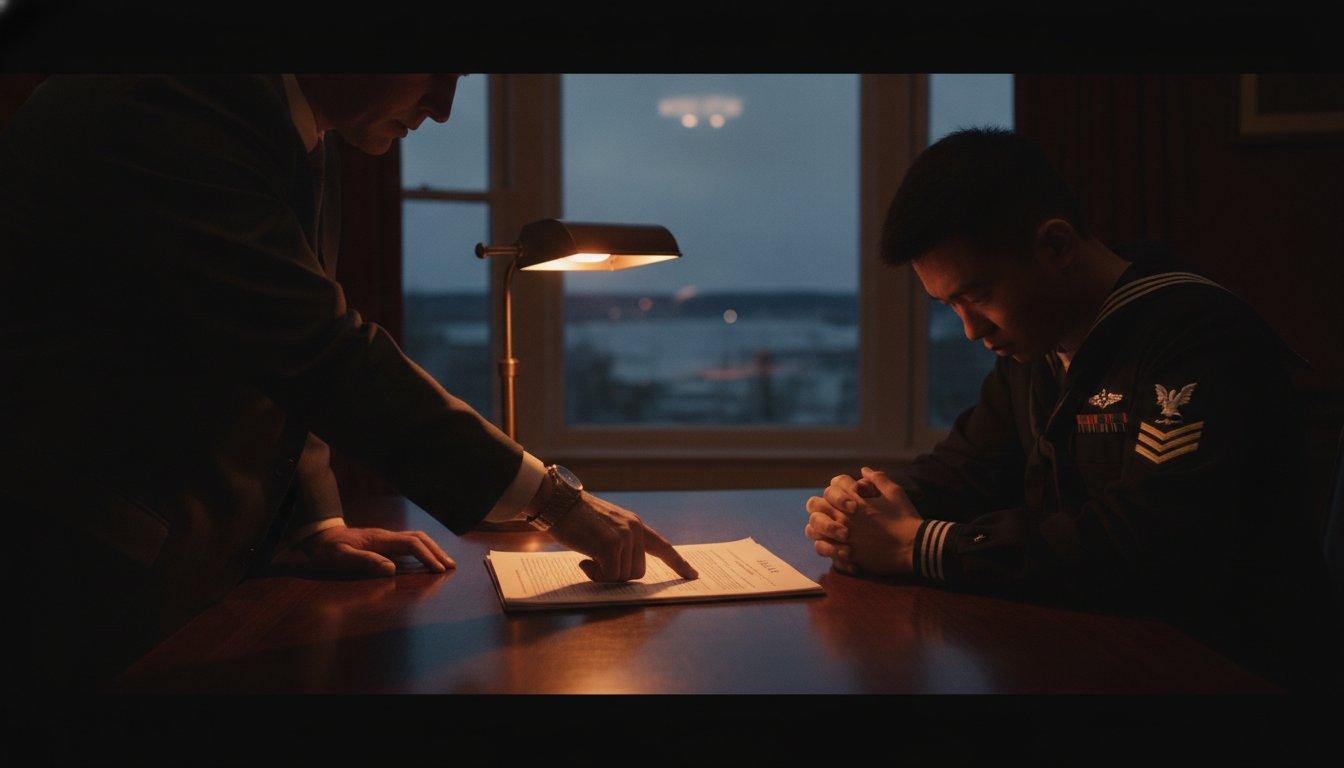
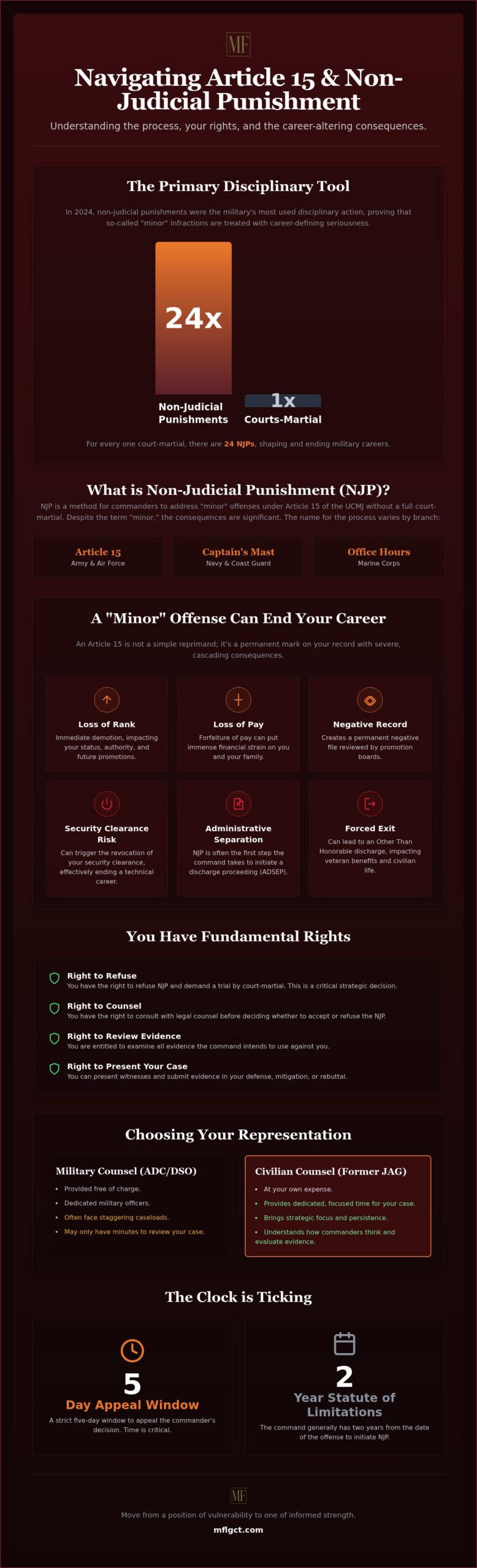
In 2024, non-judicial punishments outpaced courts-martial by a ratio of 24 to 1. This statistic proves that what the military calls “minor” disciplinary action is actually the primary weapon used to reshape or end careers. Whether you call it a Captain’s Mast, Office Hours, or an Article 15, the weight of the command is pressing down on you. You need Article 15 UCMJ representation CT that understands the high stakes of losing your rank, losing your pay, or facing administrative separation. It’s natural to feel a sense of distrust toward assigned counsel who may only have minutes to glance at your file. You deserve a defense that matches the intensity of the charges.
We understand your career and your family’s stability are on the line. Our firm provides the strategic, battle-tested advocacy needed to protect your future. This article covers the 2025 UCMJ changes, the strict five-day appeal window, and the specific strategies a former JAG uses to ensure your side of the story reaches the commander. You’ll learn how to handle this complex legal crossroad with the confidence of having a Marine Corps Major as your ally. We’re here to help you move from a state of vulnerability to a position of informed strength.
Key Takeaways
- Identify the specific career risks associated with Non-Judicial Punishment, ranging from immediate loss of pay to the threat of administrative separation.
- Recognize your fundamental legal rights, including the right to review all evidence the command is using to support the allegations against you.
- Weigh the critical decision of whether to accept NJP or demand a trial by court-martial with strategic Article 15 UCMJ representation CT.
- Learn the essential steps for building a persuasive mitigation package that ensures your side of the story and your service record are heard.
- Gain a strategic advantage by leveraging the insights of a former JAG who understands exactly how commanders evaluate evidence and character statements.
Call For A Consultation
(860) 333-6455Table of Contents
- Understanding Non-Judicial Punishment (NJP) and Article 15 in Connecticut
- Your Legal Rights During the Article 15 Process
- The High-Stakes Decision: Should You Accept or Refuse NJP?
- Strategic Defense Preparation: Building a Rebuttal and Mitigation Package
- Why Civilian Representation by a Former JAG Matters for CT Service Members
Understanding Non-Judicial Punishment (NJP) and Article 15 in Connecticut
In the military justice system, Article 15 of the UCMJ serves as a bridge between administrative corrections and the severe finality of a court-martial. Commanders utilize Non-Judicial Punishment (NJP) to address “minor” offenses without the logistical burden of a full trial. While the term “minor” suggests a low-stakes encounter, the reality for service members at Subase New London or the Coast Guard Academy is far more serious. Depending on your branch, you might hear this process called Captain’s Mast in the Navy and Coast Guard or Office Hours in the Marine Corps. Regardless of the name, seeking Article 15 UCMJ representation CT is a critical step in protecting your future. It’s vital to remember that accepting an Article 15 isn’t an admission of guilt. It’s simply a choice to have your commander decide the matter rather than a judge or jury.
The Legal Framework of Article 15
The process is governed by specific regulations, including the JAGMAN for the Navy and Coast Guard and branch-specific manuals like AFI 51-202 or AR 27-10. By 2026, these regulations continue to emphasize the commander’s discretion. Commanders prefer this route because it bypasses the complexity of a court-martial while still allowing for significant punishment. Most offenses under Article 15 have a two-year statute of limitations, meaning the command can’t reach back indefinitely to punish past mistakes. However, once the process starts, it moves with a speed that can leave a service member reeling without proper guidance. You need a defense that moves just as fast to preserve evidence and identify witnesses before they’re reassigned.
Why “Minor” Offenses Carry Major Consequences
Common offenses that trigger this process include unauthorized absence (UA), failure to repair, or general minor misconduct. These might seem like small hurdles, but they create a permanent record that promotion boards scrutinize heavily. An Article 15 can trigger the revocation of a security clearance, effectively ending a technical career. An Article 15 is a career-altering event rather than a simple reprimand. If you’re facing these charges, you’re at a strategic crossroad. Professional Article 15 UCMJ representation CT ensures that your side of the story isn’t lost in the rush to maintain “good order and discipline.” You aren’t just fighting a charge; you’re fighting for the right to continue your service and protect the rank you’ve worked years to earn.

Call For A Consultation
(860) 333-6455Your Legal Rights During the Article 15 Process
Facing a commander’s inquiry can feel like the walls are closing in, but you aren’t without protection. The Uniform Code of Military Justice grants you specific procedural safeguards designed to ensure fairness. Your Rights Under Article 15 include the fundamental right to be informed of the exact UCMJ articles you’ve allegedly violated. You also have the right to examine every piece of evidence the commander intends to use against you, the right to present witnesses, and the right to a public hearing unless classified material is involved. Perhaps most importantly, you have the right to consult with legal counsel before you decide whether to accept or refuse the forum.
Don’t view an Article 15 in isolation. Commands often use Non-Judicial Punishment as the foundation for Administrative Separation (ADSEP). If you accept the punishment without a strategic rebuttal, you’re essentially handing the command the paper trail they need to initiate a discharge. This transition from a disciplinary hearing to a career-ending separation happens faster than most service members realize. Protecting your record now is the only way to prevent a chain reaction that leads to an Other Than Honorable discharge later.
The Right to Counsel: Military vs. Civilian
While the Area Defense Counsel (ADC) or Defense Service Office (DSO) provides free assistance, their caseloads in high-activity areas like Groton or New Haven are often staggering. These are capable officers, but they may only have a few minutes to dedicate to your specific case file. This is why many seeking Article 15 UCMJ representation CT choose civilian counsel. A civilian attorney provides the dedicated time and strategic focus that an overworked military defense office simply cannot match. While civilian counsel is at your own expense, it offers a level of persistence that can be the difference between a saved career and a forced exit.
Evidence Review and Discovery
You must request the complete case file immediately. This includes witness statements, police reports, and any physical evidence held in the evidence locker. Inconsistencies often hide in the fine print of these documents. For service members at the Coast Guard Academy or Subase New London, identifying these flaws early can change the commander’s entire perspective on the incident. If you’re unsure how to interpret the evidence or find the holes in the command’s logic, consulting a military law expert can help clarify your options and strengthen your defense strategy.

Call For A Consultation
(860) 333-6455The High-Stakes Decision: Should You Accept or Refuse NJP?
Deciding whether to accept or refuse Non-Judicial Punishment is the most critical tactical decision you’ll make in your military career. When you accept an Article 15, you’re essentially agreeing to let your commander act as the investigator, judge, and jury. This forum operates under the “preponderance of the evidence” standard. This means the command only needs to be 51 percent certain of your guilt to impose punishment. It’s a low bar that favors the prosecution. Securing Article 15 UCMJ representation CT helps you navigate this trap by evaluating the strength of the command’s case before you commit to a path.
A widespread misconception among service members is that refusing NJP is an admission of guilt or a guarantee of conviction. This couldn’t be further from the truth. Refusing NJP is a legal demand for a trial by court-martial, where the government must meet a much higher burden of proof. However, this demand is a double-edged sword. While it forces a fairer process, it also opens the door to more severe punishments that a commander cannot impose at the NJP level. You aren’t just choosing a forum; you’re choosing your level of risk.
When Accepting NJP is the Strategic Move
Accepting NJP is often a calculated move to mitigate damage when the evidence is overwhelming. If the command has undeniable proof of a “minor” infraction, accepting the forum caps the maximum punishment you can receive. It limits the amount of pay you can lose, the time you can be restricted, and the number of ranks you can be reduced. Most importantly, an Article 15 is not a federal criminal conviction. For service members planning a civilian career after their term of service, avoiding the permanent “paper trail” of a federal record is often worth the immediate sting of NJP punishment. It’s about damage control and career preservation.
The Risks and Rewards of Refusing NJP
Refusing NJP shifts the standard of proof to “beyond a reasonable doubt.” This is a massive hurdle for the government. If the evidence against you is weak or based on hearsay, forcing a trial can lead to a full acquittal. But the risks are high. A court-martial conviction can result in confinement or a Bad Conduct Discharge (BCD), which carries a lifelong stigma. Keith Anthony uses his experience as a Marine Corps Reserve Major and former JAG to weigh these risks. He understands the commander’s perspective and can help you determine if the government actually has the evidence to back up their threats at trial before you make a move you can’t take back.
Strategic Defense Preparation: Building a Rebuttal and Mitigation Package
Preparation is the operational difference between a career-ending entry in your file and a minor speed bump. Once you’ve received notice of an Article 15, the clock starts. You can’t rely on the command’s investigation to be impartial or exhaustive. Effective Article 15 UCMJ representation CT begins with an independent investigation into the facts. This means identifying witnesses the command ignored and securing digital or physical evidence before it disappears. You need a defense that looks beyond the charge sheet to the reality of what actually happened on the ground.
Your defense strategy should follow a methodical five-step process:
- Step 1: Conduct an independent investigation to uncover exculpatory evidence.
- Step 2: Gather character statements from supervisors and peers who can attest to your value to the unit.
- Step 3: Draft a formal written rebuttal that addresses each allegation with surgical precision.
- Step 4: Prepare your oral presentation for the Captain’s Mast or Office Hours to ensure you speak with confidence.
- Step 5: Focus heavily on “Extenuation and Mitigation” to argue for the least severe punishment possible.
Drafting an Effective Written Rebuttal
Commanders at Subase New London or the Coast Guard Academy are often overwhelmed with administrative tasks. Your written rebuttal must be concise and mission-focused. It’s possible to point out procedural errors or factual inconsistencies without appearing disrespectful to the command. Use professional formatting to make your key defense points stand out. A well-organized document shows the commander that you take the process seriously and that you’re committed to the standards of your branch. A disciplined, professional tone often carries more weight than an emotional plea.
Mitigation: Reducing the Impact on Your Future
Even if the commander believes the offense occurred, the fight isn’t over. Mitigation is your opportunity to argue why you should keep your rank and pay. Present evidence of a stellar service record to push for a suspended sentence. If you have specific family needs or community involvement in the New Haven area, highlight these ties. Providing concrete financial hardship data can prevent the maximum pay forfeiture that would otherwise devastate your family’s stability. If you’re ready to protect your career with a battle-tested strategy, reach out to Mission Focus Legal Group for a consultation.
Why Civilian Representation by a Former JAG Matters for CT Service Members
Choosing Article 15 UCMJ representation CT is a decision that impacts your career trajectory for years. While military defense counsel offers a vital service, they often lack the time to provide the deep, strategic dive your case requires. Mission Focus Legal Group bridges this gap. Attorney Keith Anthony serves as a U.S. Marine Corps Reserve Major and brings over 10 years of experience serving the Connecticut military community. Because our firm is located near Subase New London and the Coast Guard Academy, we understand the local command climate and the specific pressures facing service members in Groton and New Haven.
Our approach combines the tactical precision of a military officer with the persistent advocacy of a civilian trial lawyer. We don’t just review your file; we investigate the facts that the command might have overlooked. This local accessibility means you aren’t just a number on a crowded docket. You have a battle-tested ally who is ready to stand by you in private consultation and throughout the disciplinary process.
The Advantage of a Former JAG
A former JAG provides a perspective you won’t find in a standard civilian firm. Keith Anthony has “been in the room” during these proceedings from the other side. He understands “Commander’s Intent,” which is the underlying goal a commander hopes to achieve through discipline. This insight allows us to frame your defense in a way that resonates with leadership rather than antagonizing it. Whether you’re dealing with the specific administrative nuances of the Coast Guard or the traditional discipline of the Navy, we recognize the inherent biases within each branch. We approach every client as a “friendly guide,” providing the steady, calming presence you need while maintaining a fierce, proactive defense against the charges.
Protecting Your Future Beyond the Uniform
The impact of an Article 15 doesn’t always end when the restriction is over. It creates a record that the command can use to justify an administrative separation board. We work to ensure your rights are protected throughout this entire lifecycle. Our goal is to prevent a minor infraction from becoming a permanent hurdle for a military discharge upgrade in the future. By building a strong mitigation package now, we help preserve your eligibility for veteran benefits and civilian employment opportunities. Don’t let a single mistake dictate the rest of your life. Contact Mission Focus Legal Group for a confidential consultation to start building your defense today.
Take Command of Your Military Future
Your service record is a testament to years of dedication; don’t let a single disciplinary event dismantle your future. We’ve explored how an Article 15 is more than a simple reprimand. It’s a strategic legal crossroad where the right decisions can preserve your rank and pay. Whether you’re weighing the risks of a court-martial or building a mitigation package, you need a battle-tested ally who understands the commander’s perspective. Our firm provides the persistent Article 15 UCMJ representation CT that service members at Subase New London and the Coast Guard Academy deserve.
Led by Attorney Keith Anthony, a Marine Corps Reserve Major and former JAG, Mission Focus Legal Group has spent over 10 years defending the rights of those who serve. We bridge the gap between military discipline and aggressive advocacy to ensure your side of the story is heard. Take the first step toward protecting your career and your family’s stability. Secure Strategic Military Defense Counsel Today. You’ve fought for your country; now let us fight for you.
Frequently Asked Questions
Can I have a civilian lawyer present during the Article 15 hearing?
Yes, you have the right to be represented by a civilian lawyer during the hearing. While the military provides free counsel from the Trial Defense Service, their availability is often limited. A civilian attorney with Article 15 UCMJ representation CT experience can attend the proceeding, present evidence, and cross-examine witnesses. This ensures your side of the story is professionally articulated directly to the commander, which is crucial for protecting your rank and pay.
Is an Article 15 considered a criminal conviction in civilian life?
No, an Article 15 is not a federal criminal conviction. It’s a form of non-judicial punishment intended for minor offenses under the UCMJ. However, it still creates a permanent record in your military personnel file. While it won’t show up on a standard civilian criminal background check, it can be seen by federal agencies or employers requiring a security clearance, potentially impacting your future career opportunities outside the uniform.
What is the maximum punishment I can receive at a Captain’s Mast?
Maximum punishments depend on the commander’s rank and the service member’s grade. For an O-4 or higher, common punishments include 30 days of correctional custody, forfeiture of half a month’s pay for two months, 60 days of restriction, and 45 days of extra duty. Enlisted members may also face a reduction in rank to the next inferior pay grade. These penalties are designed to be corrective but can significantly impact your financial and professional stability.
Can I appeal the decision of an Article 15 after the punishment is announced?
Yes, you have a strict window of 5 calendar days to submit a written appeal. This deadline is strictly enforced by the command. You can appeal on the grounds that the punishment was unjust or disproportionate to the offense. A commander may grant an extension for good cause, but it’s vital to move quickly. Professional legal assistance is essential during this short window to draft a persuasive rebuttal that identifies procedural errors.
Will an Article 15 prevent me from getting a security clearance or civilian job?
It can complicate the process, especially for jobs requiring high-level clearances. Adjudicators look for patterns of misconduct or issues with reliability and trustworthiness. While a single Article 15 for a minor infraction might not result in an automatic denial, it must be disclosed during the background investigation. Proactive Article 15 UCMJ representation CT helps you frame the incident in a way that demonstrates personal growth and continued reliability to future employers.
How long does an Article 15 stay in my military personnel file?
The duration depends on your branch and rank. For many enlisted members, the record may be removed from the permanent file after two years or upon transfer to a new command, provided no further misconduct occurs. However, for officers and certain senior enlisted personnel, the record is often permanent. It’s important to consult regulations like AR 27-10 or the JAGMAN to understand the specific retention policies applicable to your current situation.
Can the commander use NJP to initiate an administrative separation (ADSEP)?
Yes, an Article 15 is frequently used as the foundational evidence for an administrative separation board. Commands often use non-judicial punishment to establish a pattern of misconduct or to document a serious offense. If you accept the punishment without a strong rebuttal, you’re effectively providing the command with the documentation they need to end your career. Protecting your record at the NJP stage is the best way to prevent a future discharge.
Should I talk to the military defense counsel before hiring a civilian attorney?
You should take advantage of every resource available to you. Military defense counsel from the Trial Defense Service or Defense Service Office is provided at no cost. They can offer an initial assessment of the charges. However, because these offices are often overwhelmed with high caseloads, many service members choose to hire a civilian attorney to ensure they receive dedicated time, thorough investigation, and a more aggressive defense strategy tailored to their specific career goals.
Call For A Consultation
(860) 333-6455