
The moment your vehicle stops spinning, a tactical clock starts ticking, and in the legal theater of Connecticut, that clock is unforgiving. You’re likely feeling the weight of mounting medical bills and the relentless pressure of insurance adjusters who want you to settle before you’ve fully processed the trauma. It’s common to feel overwhelmed by conflicting information regarding the Connecticut car accident statute of limitations, especially when your recovery should be your only priority. You shouldn’t have to fight a war on two fronts while you’re injured.
You deserve a clear, disciplined strategy to protect your legal rights. This guide provides the high-stakes intelligence you need to execute a successful claim before your time expires. We’ll clarify the standard two-year filing window, explain the critical three-year statute of repose, and identify the strict notice deadlines for claims against government entities. By the end of this briefing, you’ll have a precise roadmap to navigate these complex legal deadlines with the confidence of a battle-tested ally standing in your corner.
Key Takeaways
- Master the standard two-year window defined by C.G.S. § 52-584 to ensure your right to compensation remains legally protected from the moment of impact.
- Identify critical exceptions to the general rule, including the absolute three-year statute of repose and specific tolling provisions for injured minors.
- Recognize the accelerated notice requirements for claims against government entities, which can be as short as 90 days for municipal road defects.
- Understand why the Connecticut car accident statute of limitations is a strategic countdown that necessitates the immediate preservation of dashcam footage and witness statements.
- Learn how a mission-driven approach, led by a former Marine Corps Judge Advocate, applies military-grade discipline to meet every legal milestone in your case.

Call For A Consultation
(860) 333-6455Table of Contents
- The Tactical Timeline: Connecticut’s 2-Year Statute of Limitations
- Exceptions to the Rule: The Statute of Repose and Tolling
- Critical Notice Deadlines for Municipal and State Claims
- The High Cost of Delay: Why Evidence Decay is Your Real Enemy
- Executing the Mission: How Keith Anthony Protects Your Claim
The Tactical Timeline: Connecticut’s 2-Year Statute of Limitations
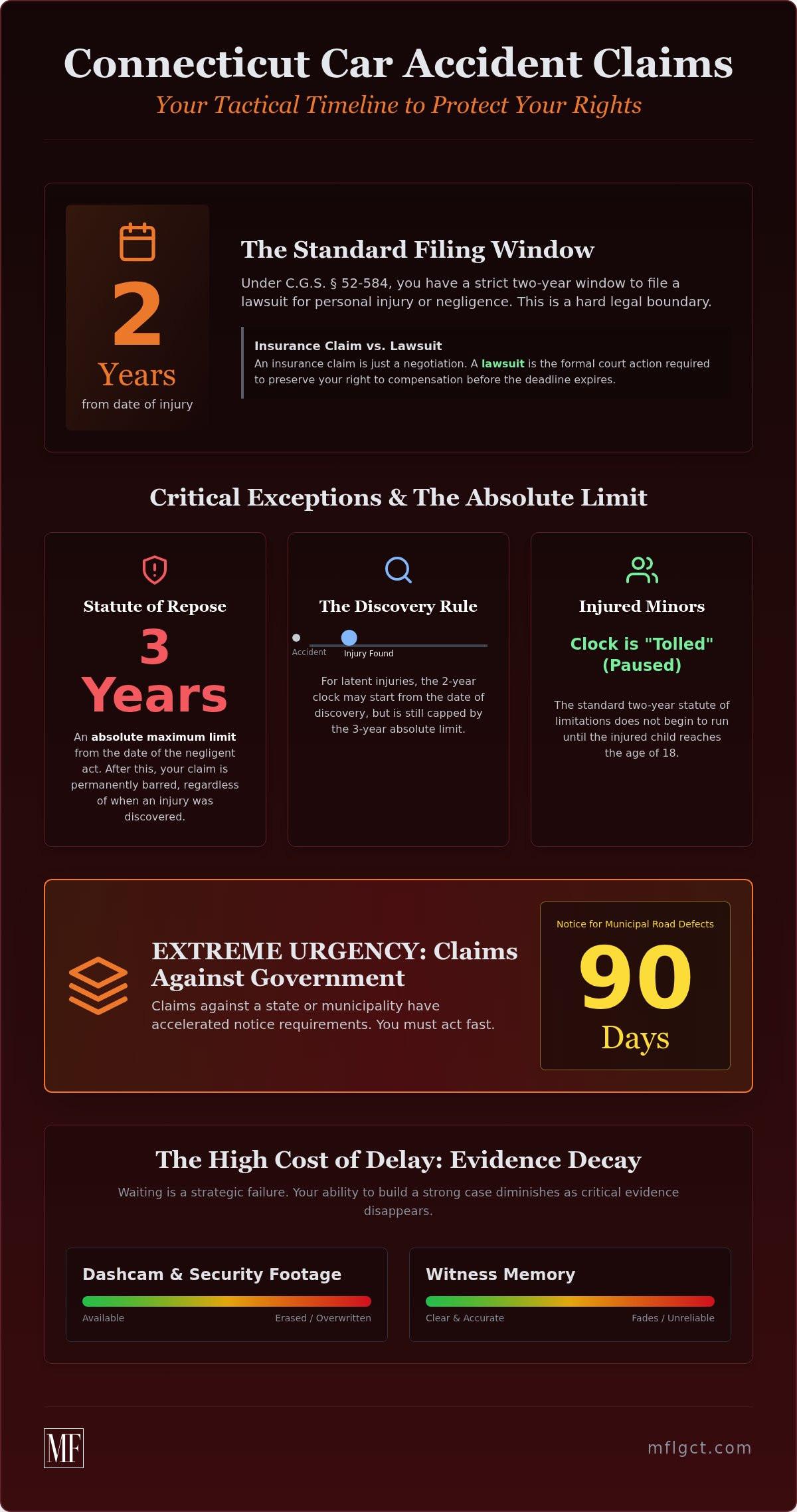
Precision is everything in legal advocacy. In Connecticut, the statute of limitations for personal injury arising from a vehicle collision is governed by Connecticut General Statutes § 52-584. This law establishes a strict two-year window from the date of the injury to file a lawsuit. For the vast majority of drivers on I-95 or the Merritt Parkway, the tactical clock begins at the moment of impact. This isn’t a suggestion; it’s a hard legal boundary that dictates the lifespan of your claim.
Don’t confuse filing a claim with your insurance company for filing a lawsuit in the Connecticut Superior Court. An insurance claim is an administrative negotiation, while a lawsuit is a formal legal action required to preserve your rights. If you spend twenty-three months negotiating with an adjuster and fail to file a formal complaint in court, your leverage vanishes instantly. Once that two-year mark passes, the court loses the authority to hear your case. This results in the permanent loss of your right to seek compensation, regardless of how severe your injuries or how clear the other driver’s fault may be.
Understanding C.G.S. § 52-584 and Negligence
Connecticut law defines negligence as a failure to use reasonable care, which leads to the harm of another person. Whether your case involves Car Accident Representation, truck collisions, or motorcycle crashes, the same two-year rule applies to claims based on negligence or reckless misconduct. For residents filing in the New Haven or Groton Superior Courts, this deadline is an absolute cutoff. From a mission-driven perspective, waiting until day 729 to take action is a strategic failure. Evidence disappears, witness memories fade, and your ability to build a formidable case diminishes with every passing month. We prioritize aggressive advocacy early in this window to secure the tactical advantage.
The Discovery Rule: When the Clock Starts Later
Some injuries don’t reveal themselves at the scene of the accident. Internal trauma, certain spinal issues, or neurological conditions might take weeks or months to manifest fully. The “Discovery Rule” acts as a narrow exception for these latent injuries, potentially allowing the two-year clock to start from the date you discovered the injury rather than the date of the crash. However, the burden of proof rests entirely on the victim. You must demonstrate through medical records and expert testimony that the injury couldn’t have been identified sooner through reasonable diligence. The discovery rule is a specific legal provision that extends the Connecticut car accident statute of limitations only for injuries that were not reasonably discoverable at the time of the initial incident.

Call For A Consultation
(860) 333-6455Exceptions to the Rule: The Statute of Repose and Tolling
Exceptions to the Connecticut car accident statute of limitations exist to protect those who are physically or legally unable to advocate for themselves. These adjustments are not signs of leniency. They are strategic safeguards built into the law to account for variables like age, mental capacity, or the movement of a defendant across state lines. Understanding these deviations is vital for maintaining your tactical position when a standard two-year window is insufficient.
The Statute of Repose (The 3-Year Limit)
While the discovery rule offers some flexibility for latent injuries, it’s governed by an absolute ceiling known as the statute of repose. Under C.G.S. § 52-584, no lawsuit can be brought more than three years after the negligent act occurred. This is a critical distinction that many victims overlook. If a complex medical issue, such as a slow-developing spinal injury or traumatic brain trauma from a New Haven crash, is discovered two and a half years after the event, you only have six months left to act. Once the three-year mark passes, your case is legally neutralized. The court will dismiss the claim regardless of when you finally realized the extent of your damages. This makes early medical intervention and consistent monitoring a mandatory part of your legal strategy.
Protecting Injured Minors
Protecting the youngest victims requires a different tactical approach. In Connecticut, the statute of limitations is “tolled” for minors. This means the two-year countdown doesn’t begin until the child reaches the age of 18. While this provides a legal safety net, waiting until a child is an adult to file a claim is often a strategic error. Physical evidence disappears, and digital data is often purged after a few years. Parents can take the initiative by acting as a “Guardian Ad Litem” to represent the child’s interests immediately. Securing Car Accident Representation early ensures that the necessary evidence is preserved while the trail is still warm, even if the legal deadline is technically years away.
Other tolling provisions apply if the victim is mentally incapable of filing at the time of the accident. Additionally, if the at-fault driver leaves Connecticut to avoid being served with a lawsuit, the clock may pause under C.G.S. § 52-590. This prevents a negligent party from simply “waiting out” the deadline by relocating. These exceptions are complex and require a disciplined review of the facts to ensure no tactical advantage is lost. Every day of delay gives the opposition more time to build a defense, so identifying these exceptions early is a mission-critical objective.

Call For A Consultation
(860) 333-6455Critical Notice Deadlines for Municipal and State Claims
Suing a government entity in Connecticut isn’t a standard legal procedure; it’s a complex tactical operation that requires breaching the shield of sovereign immunity. This legal doctrine generally protects the state and its towns from lawsuits unless specific conditions are met. While the standard Connecticut car accident statute of limitations allows for two years to file a lawsuit, claims involving government defendants are governed by much shorter, unforgiving notice periods. If you fail to provide formal notice within these windows, your case is legally neutralized before it ever reaches a courtroom.
Suing a Town or City in Connecticut
Accidents involving municipal property or employees require immediate action. If you’re struck by a New Haven city bus or a municipal vehicle in Groton, you cannot simply wait two years to act. You must file a formal “Notice of Intent to Sue” with the town clerk. The timeline depends on the nature of the claim:
- Defective Road or Bridge: If a poorly maintained municipal road caused your crash, you must provide written notice within 90 days of the incident.
- Employee Negligence: If a city employee’s driving caused the accident, written notice must typically be provided within six months.
This notice must be precise. It must include the exact date, time, and location of the accident, a detailed description of your injuries, and a clear statement of your intent to seek damages. The 90-day deadline is particularly strict. Connecticut courts rarely accept excuses for “not knowing” the law, making early legal intelligence a mission-critical requirement for your recovery.
Claims Against the State of Connecticut
Collisions on state highways like I-95 or I-91 often involve state-owned property or Department of Transportation (DOT) vehicles. These claims follow a separate protocol. Instead of filing directly in Superior Court, you must generally file a formal claim with the Office of the Claims Commissioner within one year of the incident. The Commissioner then decides whether to grant you permission to sue the State. This adds a significant layer of bureaucracy and time to your mission.
Strategic coordination is vital when multiple government entities are involved. A single accident might involve a town-owned road that intersects with a state highway. In these high-stakes scenarios, we ensure all potential government defendants are identified and notified simultaneously. Missing a single notice deadline can kill your case, even if the primary Connecticut car accident statute of limitations hasn’t expired. We apply military-grade discipline to track these overlapping timelines, ensuring no tactical advantage is surrendered to the opposition.
The High Cost of Delay: Why Evidence Decay is Your Real Enemy
The Connecticut car accident statute of limitations provides a two-year window, but your most critical evidence often has a lifespan of just a few days. While the law allows you time, the reality of evidence decay does not. Waiting to initiate your claim creates a tactical vacuum that the opposition will exploit. Human memory is notoriously fragile. Witnesses move, their recollections of the impact blur, and the specific details that prove liability begin to fade within weeks. The physical environment of the crash site is also constantly evolving. Roads are repaved, signage is replaced, and Connecticut’s harsh weather can wash away vital tire marks and debris patterns that reconstruction experts need.
Insurance adjusters are trained to view delay as a sign of weakness. If you wait months to seek medical treatment or legal counsel, they’ll argue that your injuries weren’t severe or were caused by a separate event. This “credibility gap” is a primary tool used to devalue your claim. They want you to wait until the trail is cold so they can control the narrative of the accident.
Securing the “Black Box” and Electronic Data
Modern vehicles are equipped with Event Data Recorders (EDRs), commonly known as “black boxes.” These devices capture mission-critical data such as speed, braking patterns, and seatbelt usage at the moment of collision. In commercial truck accidents, this data is even more granular, tracking hours of service and engine performance. However, this electronic intelligence is often overwritten or destroyed during vehicle repairs. We take immediate action by sending “Spoliation Letters” to insurance companies and trucking firms, legally demanding the preservation of this data. Learn how our personal injury attorney New Haven team secures this data to build an unshakeable foundation for your case.
The “Mission Focus” Investigation Strategy
We treat every accident scene like a high-stakes mission site. This requires a methodical, rapid-response investigation. We partner with accident reconstruction experts who can analyze skid marks, debris patterns, and sightlines while the evidence is still fresh. This physical data allows us to recreate the physics of the crash with mathematical certainty, leaving little room for insurance companies to dispute the facts.
Early medical evaluation is the final cornerstone of this strategy. Documenting your injuries within the first 48 hours creates a clear link between the accident and your physical trauma. This objective record is vital for calculating non-economic damages like pain and suffering. If you’ve been injured, don’t let the clock drain the strength of your case. Secure your future by getting strategic legal representation today.
Executing the Mission: How Keith Anthony Protects Your Claim
Success in a personal injury claim isn’t accidental. It’s the result of a deliberate, mission-driven strategy. When you’re facing the Connecticut car accident statute of limitations, you need more than a generic legal representative; you need a battle-tested ally who understands the weight of a deadline. Keith Anthony brings the discipline of a former Marine Corps Reserve Major and Judge Advocate to every case. This background ensures your claim is handled with the high-stakes authority required to force insurance companies to the table. We don’t just process paperwork. We execute a plan designed to secure your future.
Our Methodical Approach to Litigation
Our process starts with an initial briefing where we assess liability and identify all sources of recovery. We look beyond the obvious to find every available avenue for compensation, whether through standard liability policies or underinsured motorist coverage. Strategic execution follows, involving the management of experts, digital filings, and strict court deadlines with military precision. Our attention to complex detail, also demonstrated in our work as an education law attorney Connecticut, ensures that every tactical milestone in your car accident mission is met with accuracy. You won’t be left wondering about the status of your case. We prioritize clear communication, keeping you informed as we advance through each phase of the legal process.
Why Your Choice of Advocate Matters
The choice of your advocate matters because insurance companies monitor which attorneys are willing to go the distance. Keith Anthony’s background ensures no deadline is ever missed and no evidence is overlooked. We prepare every case as if it’s going to trial in New Haven or Groton from day one. This aggressive advocacy is often the only way to force higher settlement offers from adjusters who are used to pushing around unrepresented victims. By projecting an aura of serious professionalism and authority, we provide the protective confidence you need to stand your ground. We are not passive observers in your case; we are bold advocates who are persistent and thorough.
Don’t let the clock run out on your ability to seek justice. The Connecticut car accident statute of limitations is a hard boundary, but it doesn’t have to be a barrier to your recovery if you act with purpose. We are here to act as your steady, accessible partner in private consultation and a fierce presence in litigation. Schedule your strategic case evaluation today. Let us carry the burden of the legal fight while you focus on healing.
Secure Your Legal Standing Before Time Runs Out
The tactical window for your recovery is defined by the Connecticut car accident statute of limitations, but your strategic advantage depends on immediate action. You’ve learned that while the standard filing limit is two years, government notice deadlines can expire in as little as 90 days. Waiting for the clock to wind down only allows evidence to decay and insurance adjusters to build their defenses. Every day of delay is a day the opposition uses to undermine your claim.
You don’t have to navigate this high-stakes landscape alone. Mission Focus Legal Group, led by U.S. Marine Corps Reserve Major Keith Anthony, applies over 10 years of Connecticut trial experience to protect your rights. We provide the disciplined advocacy needed to meet every legal milestone and pursue maximum recovery for your injuries. Our battle-tested approach ensures you are never a passive observer in your own case.
Take control of your mission today. Schedule Your Mission-Focused Case Evaluation to secure a formidable ally for your journey toward justice. You’ve carried the burden of your accident long enough; let us carry the weight of the legal fight.
Frequently Asked Questions
Can I still file a car accident claim after 2 years in Connecticut?
Generally, you cannot file a claim once the two-year window passes. Connecticut General Statutes § 52-584 establishes a firm boundary for negligence claims. However, exceptions exist for injured minors or cases where an injury was not immediately discoverable. These exceptions are narrow and require high-stakes legal analysis to survive a motion to dismiss. Missing the Connecticut car accident statute of limitations usually results in a permanent bar to recovery, so acting early is a mission-critical objective.
What is the notice deadline for an accident involving a New Haven city bus?
Accidents involving municipal vehicles like a New Haven city bus follow specific notice requirements. You must provide written notice to the municipality within six months for employee negligence. If the accident involved a defective road condition, that window shrinks to just 90 days. This notice is a prerequisite to any future lawsuit. We treat these compressed timelines with extreme urgency to ensure your legal rights remain protected against government immunity.
What happens if I discover my injury a year after the crash?
If an injury is discovered a year after the crash, the two-year clock may still be running from the date of the accident. The Discovery Rule might allow the deadline to begin when the injury was reasonably discovered, but you still face the absolute three-year statute of repose. You must prove the injury was not discoverable earlier through reasonable diligence. This requires a disciplined review of medical records to establish a clear timeline for the court.
Does the statute of limitations change if the accident resulted in wrongful death?
Yes, the timeline for wrongful death is distinct. A lawsuit must be filed within two years of the date of death. However, Connecticut law also imposes a five-year limit from the date of the underlying negligent act. If the victim passes away several years after the initial accident, these overlapping deadlines create a complex tactical landscape. We provide protective confidence to families navigating these painful requirements to secure justice for their loved ones.
How does the statute of limitations apply to property damage only claims?
The Connecticut car accident statute of limitations for property damage is also two years from the date of the accident. Whether you are seeking compensation for vehicle repairs, a total loss, or damaged personal items inside the car, the same 24-month window applies. While property claims may seem less complex than personal injury missions, they still require the immediate preservation of repair estimates and scene photos to prevent insurance adjusters from devaluing your loss.
Is the deadline different if I am suing the State of Connecticut for road defects?
Suing the State of Connecticut for a road defect requires following the 90-day notice rule. You must provide written notice to the Commissioner of Transportation within 90 days of the injury. Additionally, formal claims against the state generally must be filed with the Office of the Claims Commissioner within one year. These are some of the most unforgiving deadlines in the legal theater. Failure to meet these short notice periods will neutralize your case permanently.
What if the at-fault driver was a minor at the time of the accident?
If the at-fault driver was a minor, the standard two-year statute of limitations generally still applies. Tolling provisions in Connecticut typically protect the rights of injured minors, not the negligent party. You must still file your claim against the minor driver and potentially their parents under the family car doctrine within the usual timeframe. We apply a methodical investigation to identify all liable parties and insurance policies before these critical deadlines expire.
Do I need to hire a lawyer before the statute of limitations expires?
You should hire a lawyer long before the deadline expires. Filing a lawsuit is not instantaneous; it requires drafting a formal complaint, serving the defendants, and filing with the court. Waiting until the final weeks is a strategic risk that leaves no room for error. An early investigation allows us to secure black box data and witness statements while they are fresh. This proactive approach ensures your mission is launched from a position of strength.
Call For A Consultation
(860) 333-6455