
You paid your premiums for years to protect against the unthinkable, but now that an uninsured driver has upended your life, your own insurance company isn’t your ally; they’re your primary legal opponent. It’s frustrating to realize that the safety net you’ve funded is being pulled away just as you’re facing mounting medical debt and lost wages. You expected a partner, but you found a gatekeeper. This is a common reality for many drivers, and it requires a disciplined, strategic response to overcome.
This guide will show you how to execute a successful uninsured motorist claim Connecticut and secure the maximum compensation you’re entitled to under the law. We’ll strip away the confusion surrounding Connecticut General Statutes and provide the tactical framework needed to hold your insurer accountable to the contract they signed. We’ll examine the 2026 coverage mandates, the critical three-year statute of limitations, and the specific advantages of underinsured motorist conversion coverage to ensure your financial recovery is total and your future is protected.
Key Takeaways
- UM coverage is a mandatory contractual protection in every Connecticut policy, serving as your primary defense against hit-and-runs and uninsured drivers.
- You must navigate the legal “Exhaustion Rule” by settling with the at-fault driver’s insurance before you can successfully pursue an uninsured motorist claim Connecticut.
- Differentiating between standard UM and Underinsured Motorist (UIM) coverage is essential to calculating your policy limits and ensuring you don’t leave compensation on the table.
- Filing requires a disciplined approach, beginning with immediate police reports and formal legal notice to prevent your insurer from denying your claim on technicalities.
- Strategic legal advocacy transforms your position from a vulnerable policyholder to a formidable claimant, forcing insurance companies to honor their contractual obligations.
Call For A Consultation
(860) 333-6455Table of Contents
What is an Uninsured Motorist (UM) Claim in Connecticut?
To understand your rights after an accident, you must first ask, What is an Uninsured Motorist (UM) Claim in Connecticut? In the simplest terms, it’s a legal demand made against your own insurance policy when the driver responsible for your injuries lacks any liability insurance. Under Connecticut law, this coverage is a mandatory contractual protection that insurers must provide to ensure you aren’t left holding the debt for someone else’s negligence. Essentially, your insurance company steps into the shoes of the absent at-fault carrier to provide the compensation you would have otherwise received from the liable party.
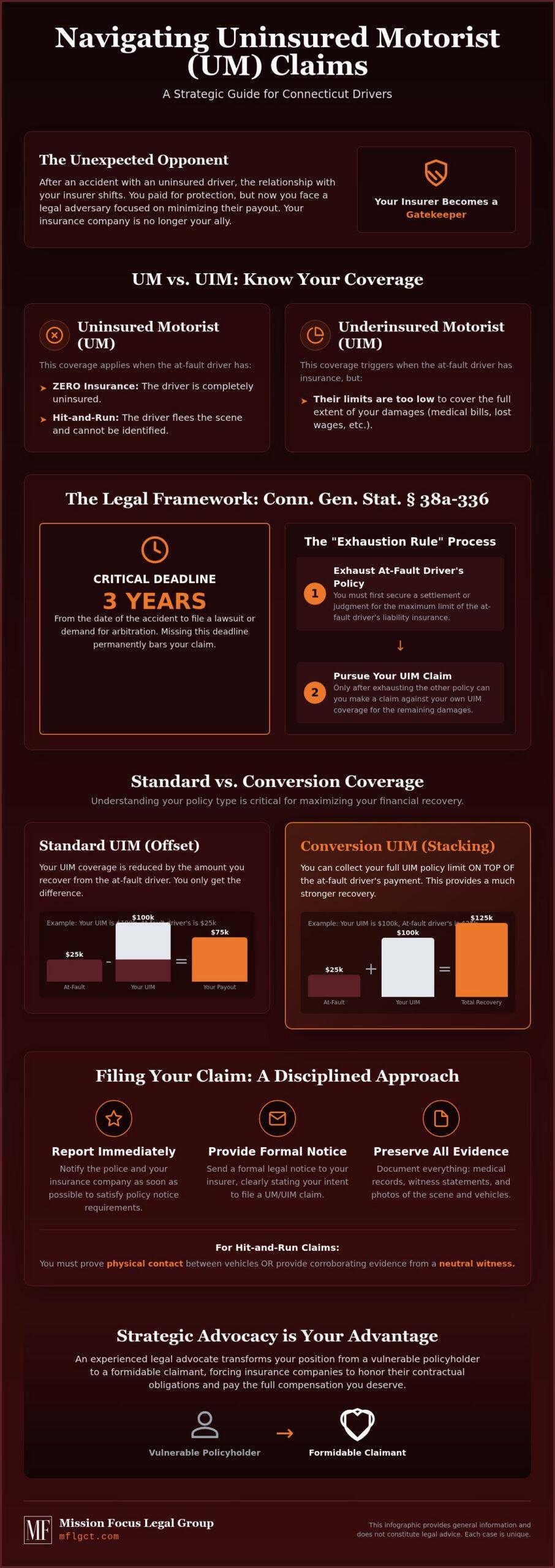
While the terms UM and UIM are often used interchangeably, they serve different tactical purposes. UM (Uninsured Motorist) applies when the other driver has zero insurance or flees the scene. UIM (Underinsured Motorist) triggers when the other driver has insurance, but their policy limits aren’t high enough to cover your total damages. Connecticut mandates this protection because, statistically, about 6.3% of drivers in the state operate without any insurance. This law ensures that responsible citizens aren’t penalized for the failures of others. However, once you file an uninsured motorist claim Connecticut, your relationship with your insurer shifts from client to adversary. They’ll look for any tactical opening to minimize your payout, which is why understanding the legal framework is your first line of defense.
Mandatory Coverage vs. Optional Add-ons
In 2026, Connecticut requires minimum limits of $25,000 per person and $50,000 per accident for UM/UIM. You can find your specific coverage amounts on your policy’s “Declarations Page,” which acts as the mission brief for your contractual rights. While minimums are the law, they’re often insufficient for catastrophic injuries. This is where Underinsured Motorist Conversion Coverage becomes vital. Under standard UIM, if the other driver has $25,000 and you have $50,000, your insurer only pays the $25,000 difference. Conversion coverage allows you to collect your full $50,000 on top of the other driver’s limits, providing a much stronger recovery position and ensuring your medical debt doesn’t outpace your insurance benefits.
Hit-and-Run Accidents in Connecticut
When a driver flees the scene, they’re legally classified as “uninsured” for the purpose of your recovery. To successfully pursue an uninsured motorist claim Connecticut after a hit-and-run, you generally must prove there was physical contact between the vehicles or provide corroborating evidence from a neutral witness. Preserving your right to recovery requires immediate action. You must report the incident to the police and notify your insurer promptly to satisfy the notice requirements of your policy. Our firm applies a disciplined discovery process to these cases, treating the accident scene like a site of investigation to ensure no piece of corroborating evidence is overlooked.

Call For A Consultation
(860) 333-6455Connecticut General Statutes Section 38a-336: The Legal Framework
Every auto insurance policy issued in the state is strictly governed by Connecticut General Statutes Section 38a-336. Think of this statute as the rules of engagement for your recovery. It mandates that insurance carriers provide coverage for damages caused by motorists who are either uninsured or underinsured. The Connecticut Insurance Department oversees these regulations to ensure carriers don’t skirt their contractual duties. However, the law also imposes rigid timelines. Per section 38a-336(g)(1), you generally have three years from the date of the accident to file a lawsuit or a demand for arbitration. Missing this deadline is a fatal tactical error that permanently bars your right to compensation.
The Exhaustion Requirement Explained
You can’t engage your own carrier for an uninsured motorist claim Connecticut until you’ve satisfied the “Exhaustion Rule.” This statutory mandate requires you to first exhaust the liability limits of the at-fault driver’s insurance through a settlement or a formal judgment. Only after that primary layer of insurance is depleted does your underinsured motorist coverage trigger. This two-step process is a common point of failure for unrepresented victims. If you settle with the at-fault driver without following specific notice protocols, your own insurer might argue you’ve prejudiced their rights and deny your claim entirely. If you’re struggling to interpret your policy’s limits, securing car accident representation can provide the tactical leverage needed to manage these complex transitions.
Stacking Coverage in Connecticut
Coverage “stacking” refers to the ability to combine the UM/UIM limits of multiple vehicles on a single policy to increase your total recovery ceiling. In Connecticut, stacking is generally allowed for individual policies but is frequently excluded in fleet or commercial policies. For example, if you have three cars on one personal policy, each with $50,000 in coverage, you might have access to $150,000 in total protection. Analyzing policy language for stacking opportunities requires a methodical review of the fine print. We look for hidden coverage and specific definitions that insurers often overlook or fail to disclose during initial negotiations. This disciplined discovery process ensures that no available resource is left off the table when calculating your final reimbursement.

Call For A Consultation
(860) 333-6455UM vs. UIM: Navigating the Differences in Recovery
Distinguishing between Uninsured Motorist (UM) and Underinsured Motorist (UIM) coverage is the foundation of a successful uninsured motorist claim Connecticut. UM coverage triggers when the at-fault party has no liability policy at all or when a hit-and-run driver cannot be identified. UIM coverage, by contrast, applies when the liable driver has insurance, but their policy limits fall short of the damages you’ve sustained. Understanding Why Strategic Advocacy Matters in UM/UIM Litigation is critical because your recovery often depends on how these policies interact with state law.
In standard Connecticut UIM claims, insurers typically use a “gap” calculation. They subtract the at-fault driver’s liability limit from your own UIM limit. If you have $100,000 in UIM and the other driver has the state minimum of $25,000, your policy only provides $75,000 in additional support. This is why Underinsured Motorist Conversion Coverage is the superior strategic choice for Connecticut drivers. Conversion coverage doesn’t allow for this subtraction. It allows you to access your full policy limits regardless of what the other driver’s insurance pays, up to the total value of your losses, providing a much wider safety net.
Scenario Analysis: When $25,000 Isn’t Enough
Medical costs for common accidents often spiral beyond the state-mandated $25,000 minimum liability limit. A single emergency room visit, diagnostic imaging, and subsequent orthopedic surgery can easily exceed $50,000 before physical therapy even begins. When you factor in lost wages from weeks or months away from work, a $25,000 policy from the at-fault driver is practically invisible. If you’ve filed an uninsured motorist claim Connecticut, a $100,000 UIM policy provides the necessary buffer to cover these high-stakes expenses without draining your personal savings or retirement accounts.
Protecting Your Family with Higher Limits
Relying on minimum limits is a financial trap that leaves New Haven families vulnerable to long-term medical debt. Increasing your UM/UIM limits is one of the most cost-effective ways to protect your household’s professional standing and financial stability. In addition to robust auto coverage, a comprehensive safety net from providers like Limitless Insurance Group can help ensure your family is protected against a wider range of financial risks. The premium difference between a $25,000 policy and a $250,000 policy is often negligible compared to the risk of a multi-million dollar medical bill. We view these higher limits as a defensive perimeter. They ensure that if the unthinkable happens, you have the resources to maintain your quality of life while you focus on recovery, rather than fighting to keep your home.
Success in a legal recovery mission requires a precise checklist. You cannot afford to miss a single procedural step when pursuing an uninsured motorist claim Connecticut. Every action you take immediately following an accident serves as the foundation for your eventual settlement or trial verdict. We approach these claims with a methodical rigor that mirrors military operational planning, ensuring that every piece of evidence is secured and every deadline is met.
- Step 1: Secure the Police Report. Obtain the official record immediately. This document is the primary source for verifying the other driver’s insurance status or confirming a hit-and-run.
- Step 2: Submit the UM/UIM Notice. This is a formal legal notification to your own carrier that a claim is pending. Failing to do this correctly can result in a total loss of benefits.
- Step 3: Document Expenses. Track every medical bill, pharmacy receipt, and hour of lost work. This data determines the total value of your claim.
- Step 4: Exhaust the Primary Policy. As discussed, you must settle with the at-fault driver’s carrier first. This step requires careful coordination to avoid “prejudicing” your own insurer’s rights.
- Step 5: Initiate Litigation. If your insurer refuses a fair settlement, we move to formal demand or arbitration to force compliance with your policy contract.
The Critical Importance of the UM/UIM Notice
The UM/UIM Notice is a strategic gatekeeper. Under Connecticut General Statutes § 38a-336(g)(1), you generally have a three-year window to commence suit or arbitration, but your policy likely requires “prompt” notice much sooner. If you wait too long, your insurance company will argue they lost the chance to investigate the scene, which often leads to a claim denial. We manage these deadlines for our clients in Groton and New Haven, drafting precise language that reports the facts without inadvertently admitting fault or undermining the severity of your injuries.
Special Considerations for Military Service Members
For service members stationed at the Naval Submarine Base New London or living in the surrounding area, an accident involves more than just medical bills. An injury can jeopardize your duty status, deployment readiness, and long-term professional standing. Coordinating with TRICARE and understanding how military benefits interact with a civilian uninsured motorist claim Connecticut is essential to avoid benefit offsets or legal complications. If your injuries have interrupted your academic progress under the GI Bill, an Education Law Attorney Connecticut can help protect your student rights while we handle the insurance litigation. If you’re ready to secure your recovery, contact us today to start your strategic evaluation.
Why Strategic Advocacy Matters in UM/UIM Litigation
When you initiate an uninsured motorist claim Connecticut, the dynamic of your relationship with your insurance carrier undergoes a fundamental shift. For years, you’ve been a loyal policyholder, but the moment you demand a payout, you’re viewed as a liability to their profit margins. Your insurer is no longer your protector; they’re your primary legal adversary. They’ll use every tool in their arsenal to minimize your recovery, from questioning the necessity of your medical treatment to disputing the severity of your pain and suffering. This transition requires a forceful, disciplined response to ensure your contractual rights are upheld.
Our approach is rooted in the strategic mindset of military leadership. Attorney Keith Anthony brings the experience of a Marine Corps Reserve Major and former JAG officer to every case we handle. We don’t wait for the insurance company to offer a fair settlement; we prepare every uninsured motorist claim Connecticut as if it’s heading to trial. This level of preparation forces the opposition to recognize that we’re ready for a high-stakes engagement. By building a comprehensive evidence file from day one, we eliminate the insurer’s ability to stall or lowball your compensation.
Fighting the Insurance Company’s Tactics
Insurers utilize several standard maneuvers to devalue your claim, most notably the “Independent Medical Exam” (IME). Despite the name, these doctors are often selected and paid by the insurance company to provide a report that undermines your treating physician’s findings. We counter these tactics through aggressive discovery and thorough cross-examination of their experts. We also look for gaps in their investigation, using our own network of specialists to prove the full impact of your injuries. Our goal is to expose the reality of your medical debt and lost wages, leaving the insurer with no choice but to negotiate from a position of weakness.
The Mission Focus Legal Group Advantage
We provide a unique blend of high-stakes authority and compassionate guidance for our clients in New Haven, Groton, and across the state. We understand that behind every legal file is a person fighting to regain their stability after a traumatic event. Our communication is disciplined and transparent; you’ll always know the status of your mission and the next tactical step we’re taking. We’re not just processing paperwork; we’re protecting your future and ensuring that a reckless driver’s lack of insurance doesn’t lead to your financial ruin. We stand as a persistent, formidable force against any carrier that tries to retreat from its obligations.
Take Command of Your Legal Recovery
Securing a successful outcome for an uninsured motorist claim Connecticut requires more than just patience; it demands a tactical approach to overcome insurance company resistance. You’ve learned that while state statutes like CGS 38a-336 define the rules, your disciplined actions in the aftermath of an accident determine the final result. By satisfying the exhaustion rule and maintaining meticulous documentation, you position yourself to hold your insurer accountable to the contract you’ve paid for. It’s time to shift from a state of vulnerability to a position of informed strength.
Mission Focus Legal Group, led by Attorney Keith Anthony, a USMCR Major and former JAG, provides the aggressive advocacy needed for high-stakes car, truck, and motorcycle accident cases. With over 10 years of service in Connecticut, we apply military-grade precision to every legal discovery and litigation phase. We’re ready to act as your steady, authoritative partner in this complex landscape. Contact Mission Focus Legal Group for a Strategic Consultation and let us lead the charge for your full reimbursement. Your recovery is our mission, and we’re prepared to see it through.
Frequently Asked Questions
Will my insurance rates go up if I file an uninsured motorist claim in Connecticut?
Your rates shouldn’t increase in Connecticut if the accident wasn’t your fault. State law generally prevents insurance companies from penalizing you for utilizing the coverage you’ve paid for when another driver is liable. Because an uninsured motorist claim Connecticut is a contractual protection, filing it is simply enforcing your policy rights. We recommend reviewing your specific policy language to ensure no unique exclusions apply to your situation.
How long do I have to file a UM/UIM claim in CT?
You generally have three years from the date of the accident to file a lawsuit or demand arbitration under Connecticut General Statutes Section 38a-336. However, you must provide prompt notice to your carrier much earlier to avoid potential denial based on a lack of investigation time. This timeline is strict, and missing it acts as a permanent bar to your recovery. Acting immediately ensures your legal team can secure evidence before it disappears.
What is the difference between standard UIM and UIM Conversion coverage?
Standard UIM coverage subtracts the at-fault driver’s liability limits from your own policy limits, often leaving a significant gap in your recovery. UIM Conversion coverage is superior because it allows you to collect your full policy amount on top of whatever the at-fault driver’s insurance pays. This ensures that your total compensation isn’t diminished by the presence of a small, state-minimum policy from the other party.
Can I file a UM claim if I was a pedestrian hit by an uninsured driver?
Yes, your own uninsured motorist coverage typically extends to you even when you aren’t inside a vehicle. If you’re a pedestrian or cyclist struck by an uninsured driver, your auto policy treats the incident as a covered event. This protection is vital for residents in high-traffic areas like New Haven where pedestrian accidents are frequent. We analyze your policy to ensure all household-member protections are fully engaged for your recovery.
Do I need a lawyer for a UM claim if it is my own insurance company?
You absolutely need representation because your insurance company becomes your legal adversary the moment you file an uninsured motorist claim Connecticut. Their goal is to preserve their capital by minimizing your payout, regardless of your loyalty as a customer. A disciplined advocate applies the pressure necessary to force a fair evaluation. Without a lawyer, you’re negotiating against a professional team designed to devalue your medical debt and suffering.
What happens if the at-fault driver has insurance but their company denies the claim?
If the at-fault driver’s insurance company denies coverage or becomes insolvent, the driver is legally considered “uninsured” under Connecticut law. This allows you to shift your recovery efforts to your own UM policy immediately. This transition requires careful legal maneuvering to ensure you meet all notice requirements. Our firm manages this shift by conducting thorough discovery to confirm the denial and trigger your contractual protections without delay.
Can I recover for pain and suffering in an uninsured motorist claim?
You can recover for pain and suffering just as you would in a standard lawsuit against an at-fault driver. Your insurance company is contractually obligated to pay the damages you’re “legally entitled to recover,” which includes non-economic losses like physical pain and emotional distress. Proving these damages requires a strategic presentation of medical evidence and personal testimony. We ensure your total human impact is documented to secure maximum compensation.
Call For A Consultation
(860) 333-6455