
Your financial stability isn’t a matter of luck; it’s a mission-critical objective that requires precise execution. When you’re facing the complexities of Connecticut child support laws, the stakes couldn’t be higher for your future and your child’s well-being. We understand the weight of this responsibility. You likely feel the pressure of an “Income Shares” model that seems designed to confuse, coupled with the legitimate fear that a single miscalculation could leave you financially compromised or unable to provide.
This strategic guide is designed to replace that anxiety with tactical clarity. You’ll learn how to master the Connecticut child support formula to protect your interests and ensure your child is provided for fairly. We’re going to examine the significant 2026 updates to the income schedule, clarify the division of medical and childcare expenses, and outline a disciplined plan for modifying your order if your circumstances change. It’s time to move from a state of vulnerability to a position of informed strength. By understanding the rules of engagement, you can secure a future that’s both stable and just.
Key Takeaways
- Understand how the Income Shares Model combines parental net weekly incomes to ensure children receive a consistent proportion of support regardless of the parents’ living situation.
- Master the five-phase disciplined approach to calculating support under the updated 2026 Connecticut child support laws to ensure every financial detail is accurately captured.
- Identify the specific legal criteria that allow the court to deviate from standard mathematical formulas when the guideline amount is deemed unjust or inappropriate.
- Learn how to strategically modify existing orders to reflect current financial realities and ensure your child’s future remains a top priority.
- Discover why a mission-ready, tactical legal defense is essential for navigating high-stakes family law litigation and protecting your long-term financial stability.

Call For A Consultation
(860) 333-6455Table of Contents
Understanding the Connecticut Income Shares Model
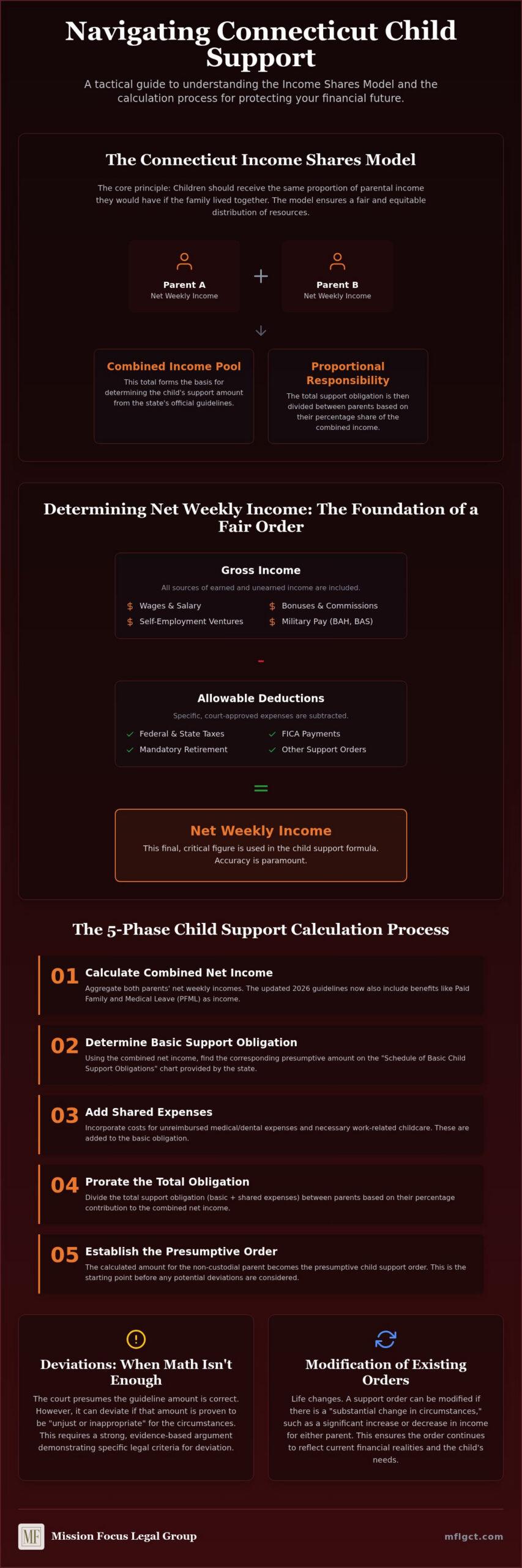
Connecticut child support laws operate on a fundamental premise: children shouldn’t suffer financially because their parents live in separate households. To achieve this, the state utilizes the “Income Shares Model.” This legal framework acts as a strategic mechanism for equitable resource distribution between households, ensuring that a child receives the same proportion of parental income they would’ve enjoyed if the family remained intact. It’s a disciplined approach that prioritizes the child’s needs while acknowledging the financial realities of both parents.
The calculation begins by combining the net weekly incomes of both parents to determine a total “basic support obligation.” This isn’t a random figure. It’s a standardized amount established by the Connecticut Commission for Child Support Guidelines. These guidelines are designed to be comprehensive. They apply to all children until they reach age 18, or age 19 if they’re still full-time high school students. By pooling resources on paper first, the state determines what the total “child cost” should be before dividing that responsibility proportionally between the parents.
Determining Net Weekly Income
Accuracy in financial disclosure is the foundation of a fair order. We start with gross income, which includes every dollar earned from wages, bonuses, commissions, and self-employment ventures. However, Connecticut child support laws focus specifically on “net income” to reflect your actual spending power. This requires a methodical deduction process. Allowable deductions typically include:
- Federal and state income taxes.
- Social Security and Medicare (FICA) payments.
- Mandatory retirement contributions.
- Existing court-ordered support for other children or spouses.
Net income is often the most fiercely contested figure in family court. Disputes regarding the consistency of bonuses or the true earnings of a self-employed parent can derail a calculation. It’s a high-stakes variable. A disciplined review of paystubs and tax returns is essential to ensure the final number reflects reality rather than an inflated or deflated projection.
The Role of the Connecticut Child Support Guidelines
Every case relies on the “Schedule of Basic Child Support Obligations.” This schedule provides a presumptive amount that the court considers legally correct at the outset. To reach this number, both parties must complete the Worksheet (Form JD-FM-220). This document is the primary tactical tool used by judges and attorneys alike to map out the financial landscape of the split. It’s the mission map for the entire support process.
The court starts with a strong presumption that the guideline amount is the right one. Overcoming this presumption requires a strategic argument. The guidelines are intended to provide stability and predictability across the state. Without a clear, evidence-based reason to move away from these standards, the math on the worksheet usually dictates the final order.

Call For A Consultation
(860) 333-6455Step-by-Step: How Child Support is Calculated in CT
Precision is the difference between financial stability and a future defined by legal disputes. Connecticut child support laws mandate a methodical, five-phase process to ensure transparency and fairness for all parties involved. This isn’t a suggestion; it’s a mission requirement for the court. Accurate calculation requires a disciplined approach to financial disclosure. Every stream of revenue must be identified and verified to avoid the risk of a “Motion for Contempt” if undisclosed assets surface later. For those managing ongoing payments, the Support Enforcement Services provides the official framework for monitoring compliance and ensuring orders are followed as written.
Step 1: Calculate Combined Net Income
The first objective is identifying the total “pot” available for the child’s needs. This involves aggregating income from both parents, including non-traditional sources like rental property dividends and investment returns. Under the updated 2026 guidelines, even Paid Family and Medical Leave (PFML) benefits are now treated as income. For our service members stationed in Groton or elsewhere, this phase is particularly critical. Military pay components such as Basic Allowance for Housing (BAH), Basic Allowance for Subsistence (BAS), and flight pay are generally included in the calculation. Strategic advocacy during this phase ensures that “imputed income” isn’t unfairly assigned to a parent who is genuinely between jobs or pursuing necessary education.
Step 2: Apply the Guideline Percentage
Once the combined net income is verified, we apply the state-mandated schedule to find the presumptive support amount. As of August 1, 2026, the income schedule has been expanded to cover combined net weekly incomes up to $6,000, which is approximately $312,000 annually. This expansion provides a standardized approach for higher-earning families that was previously left to judicial discretion. We then determine each parent’s “pro-rata” share. If your income accounts for 60% of the combined total, your share of the basic obligation will reflect that 60% ratio. The number of children also shifts these percentages significantly, as the state recognizes the increased costs of larger households.
Step 3: Adjusting for Medical and Childcare Costs
The basic obligation only covers the essentials. We must then adjust for mandatory additions that protect the child’s health and the parents’ ability to work. This includes adding the cost of health insurance premiums and work-related childcare expenses to the total. Unreimbursed medical expenses are typically shared based on the pro-rata income percentage established in the previous step. This ensures that the costs of a child’s health and safety are distributed fairly according to each parent’s actual financial power. If you’re concerned about how these percentages apply to your specific situation, Family Law Representation can provide the strategic oversight needed to verify the math and protect your stability.

Call For A Consultation
(860) 333-6455Deviations: When the Standard Math Doesn’t Apply
The Connecticut child support guidelines provide a baseline, but they aren’t always the final word. A deviation occurs when the court determines the standard amount is “unjust or inappropriate” for a specific case. To secure a departure from the presumptive math, you must present “clear and convincing” evidence to the judge. This is a high evidentiary bar. Strategically identifying these factors is where Mission Focus Legal Group excels, ensuring your financial reality is accurately reflected in the final order. We approach these deviations with the same discipline used in military planning, leaving no variable unexamined.
Common Grounds for Support Deviation
The law recognizes that some families face unique financial pressures that the standard formula cannot capture. Extraordinary parental expenses, such as high travel costs for visitation or significant disparities in parental assets, can justify a deviation. Additionally, the special needs of a child require a tailored approach. Whether a child has intensive medical, educational, or psychological requirements, the court can adjust support to meet those specific demands. We also analyze the coordination of total family support. If substantial alimony is already being paid, the amount determined by Connecticut child support laws may be adjusted to ensure the overall financial mission remains sustainable for both households.
Shared Physical Custody Adjustments
Many parents believe the “40/60” rule provides an automatic discount on support payments. This is a common myth. Connecticut law doesn’t grant a reduction simply because a child spends significant time in both homes. To trigger a downward deviation, you must prove that the shared arrangement actually reduces the other parent’s costs. It requires a methodical presentation of how expenses like groceries, utilities, and transportation are distributed. Without this tactical evidence, the court will likely stick to the guideline amount regardless of the overnight schedule. We help clients build a data-driven case to show how shared custody impacts the actual cost of raising the child.
Post-Secondary Education Support
Connecticut is one of the few states where courts can issue “educational support orders” for college expenses under C.G.S. § 46b-56c. These orders are separate from standard child support and come with a specific “UConn Cap.” This means the court generally cannot order a parent to pay more than the cost of a full-time, in-state student at the University of Connecticut. Navigating these complex orders requires specialized knowledge of both family and education law. Working with an education law attorney Connecticut ensures these obligations are managed with precision. This proactive defense protects your long-term financial stability while supporting your child’s academic future.
Modification and Enforcement of Support Orders
A court order is a directive, but it isn’t immutable. Your life and financial status are dynamic, and your legal obligations should reflect that reality. Under Connecticut child support laws, a “substantial change in circumstances” serves as the legal threshold for requesting a modification. Delaying this move is a tactical error that can lead to devastating consequences. Unpaid support accumulates as “arrearages,” and state law generally prevents judges from retroactively erasing debt that accrued before you filed your motion. Protecting your financial perimeter requires immediate action the moment a significant life change occurs.
Seeking a Modification of Support
The “15% Rule” is your primary indicator for legal movement. If a new calculation based on current income results in a figure that differs by 15% or more from your existing order, the court presumes a modification is justified. This often happens following a job loss, a significant promotion, or the onset of a disability. Changes in the child’s primary residence also necessitate a strategic review of the order. We strongly advise against “handshake agreements” regarding support. An informal pact to pay less during a hardship has no legal standing. If you don’t formalize the change through the court, you remain legally liable for the original amount, regardless of any private promises made between parents.
Enforcement and Contempt of Court
Failure to comply with a support order triggers aggressive state intervention. Enforcement is often managed through Support Enforcement Services (SES), which operates within the Groton and New Haven court systems. This agency has the authority to initiate wage garnishment, intercept tax refunds, and even trigger driver’s license suspensions. If you’re served with a Motion for Contempt, the stakes are incredibly high. You must demonstrate that your failure to pay wasn’t a “willful” act of defiance but rather a genuine, documented inability to pay. We help clients prepare a disciplined defense to prove they’ve acted in good faith despite financial setbacks, ensuring the court sees the full context of their situation.
If your current order no longer reflects your financial reality, you need a battle-tested ally to lead the modification process. Contact us for Family Law Representation to secure a fair and sustainable future for you and your child.
Strategic Advocacy with Mission Focus Legal Group
Legal disputes shouldn’t feel like a chaotic retreat. When you’re dealing with Connecticut child support laws, you need more than just a lawyer; you need a disciplined protector who understands the weight of your financial future. Mission Focus Legal Group approaches every case with the precision of a military operation. We provide the “protective confidence” necessary to navigate high-stakes family law litigation. From our base of operations in Groton to our reach in New Haven and across the state, we treat your case as a mission where the primary objective is your child’s well-being. This commitment to safety is shared by organizations like the Lotus Justice and Support Centre, which provides specialized education for understanding and preventing domestic violence. Precision matters. We don’t just fill out forms; we build unshakeable strategies.
Keith Anthony brings a unique perspective to family law as a Marine Corps Reserve Major. This background allows him to bring order to legal chaos, ensuring that no detail is overlooked during discovery or trial. He understands the discipline required to win in complex environments. Many firms struggle with the intricacies of military pay structures, but our deep expertise in identifying and calculating BAH, BAS, and flight pay ensures that service members and their spouses receive a fair and accurate calculation. We prioritize tactical preparation for every hearing. This commitment to clear communication means you’re never left wondering about the status of your case or the next step in the process.
Taking the Next Step in Your Case
Success in the courtroom starts long before the judge takes the bench. It begins with “mission-ready” preparation. We guide you through the process of gathering comprehensive financial records early, which is essential for a successful outcome. This includes everything from traditional tax returns to documentation of the extraordinary expenses and deviations we discussed earlier. Proactive movement is your best defense. By organizing your evidence now, you prevent the other side from controlling the narrative. We’re here to carry that burden for you, providing a steady and calming presence while we fight for the stability your family deserves. It’s time to move from a state of uncertainty to a position of informed strength.
Don’t leave your financial stability or your child’s future to chance. You need a battle-tested ally who understands the rules of engagement in Connecticut courts. Schedule your strategic consultation with Mission Focus Legal Group today and ensure your mission is handled with the discipline it requires.
Secure Your Strategic Financial Future
Mastering the intricacies of Connecticut child support laws requires more than just a calculator; it demands a disciplined, mission-ready strategy. We’ve explored how the 2026 guidelines expanded the income schedule and why identifying every source of net income is vital for a fair outcome. Whether you’re navigating a new order or seeking a modification due to a substantial change in circumstances, precision is your greatest asset. At Mission Focus Legal Group, we bring a unique perspective to family law. Led by Attorney Keith Anthony, a U.S. Marine Corps Reserve Major, our firm has served Connecticut for over 10 years with deep expertise in complex military and education law matters. We treat your family’s stability as a high-stakes objective that requires persistent, thorough advocacy. Protect your family’s future—contact Mission Focus Legal Group for a strategic consultation. You don’t have to carry this burden alone. With a battle-tested ally by your side, you can move forward with the confidence that your child’s future is secure.
Frequently Asked Questions
How is child support calculated if I am self-employed in Connecticut?
Self-employed individuals in Connecticut must provide a detailed accounting of their business finances to determine net income. The court starts with gross receipts and subtracts legitimate, necessary business expenses. This process is often highly scrutinized in New Haven courts to ensure income isn’t being hidden or artificially deflated. You’ll need to present clear tax returns and profit-and-loss statements to establish a transparent financial baseline for your calculation.
Can child support be ordered if we were never married?
Child support can absolutely be ordered regardless of your marital status. If you weren’t married, the legal process begins by establishing paternity through an Acknowledgement of Paternity or a court order. Once paternity is confirmed, the same Connecticut child support laws and mathematical formulas apply as they would in a divorce. The objective remains ensuring the child receives equitable financial support from both legal parents based on their combined income.
What happens to child support if the paying parent loses their job?
If you lose your job, you must file a motion for modification with the court immediately. Support orders remain in effect until a judge changes them, and unpaid balances accumulate as permanent debt. Handshake agreements with the other parent provide no legal protection. In cities like Milford or West Haven, the court requires documented proof of your job search to determine if your income should be temporarily adjusted or imputed at a higher rate.
Does Connecticut child support cover private school tuition?
Basic child support orders typically don’t cover private school tuition. However, a judge may order tuition sharing as a deviation if the child has always attended private school or if both parents previously agreed to it. This is a complex area of litigation that requires proving the education is in the child’s best interest. We help clients in Old Saybrook and Guilford present the necessary evidence to justify these additional costs.
How long does a parent have to pay child support in CT?
Support obligations in Connecticut generally continue until the child reaches age 18. If the child is still a full-time high school student, the obligation extends until graduation or age 19, whichever occurs first. It’s important to distinguish this from educational support orders for college, which can be issued separately. Parents in Groton should review their specific orders to ensure they understand when their financial mission officially concludes under state law.
Can I waive child support if both parents agree?
Parents cannot simply agree to waive child support because the law views support as a right belonging to the child, not the parent. While you can propose a deviation from the guideline amount, a judge must find that the standard calculation would be unjust or inappropriate. The court’s primary mission is the child’s well-being. Any agreement to deviate must be backed by clear evidence that the child’s needs will still be met.
How does military BAH affect my child support calculation?
Military pay components like Basic Allowance for Housing (BAH) and Basic Allowance for Subsistence (BAS) are included as income under Connecticut child support laws. For service members stationed near Groton, this often increases the net income used in the calculation. Since these allowances are non-taxable, the court may gross up the value to reflect their true financial impact. Our firm’s military background ensures these specific pay structures are calculated with tactical precision.
What is the “presumptive” child support amount?
The presumptive amount is the specific dollar figure generated by the state’s official child support worksheet. Connecticut courts begin every case with the legal assumption that this math is correct and fair. Overcoming this presumption requires a strategic argument for a deviation based on extraordinary circumstances or special needs. It serves as the baseline for all support discussions in courts from Branford to Norwich, providing a standardized starting point for every family.

Call For A Consultation
(860) 333-6455