A single legal misstep or an aggressive command decision can dismantle a decade of honorable service in a matter of hours. When you’re facing a court-martial, the stakes aren’t just about a job; they’re about your identity, your veterans benefits, and your future freedom. As a dedicated court martial lawyer Connecticut service members trust, we understand that the confusion between civilian and military legal rights only adds to the pressure. It’s a position no service member wants to be in, but you don’t have to face this front alone.
Mission Focus Legal Group brings a strategic Marine Corps mindset to your defense. We promise to help you handle the complexities of the UCMJ with a battle-tested strategy tailored to your specific situation. This article provides a clear roadmap for your legal mission ahead. We’ll explore how to protect your rank, the critical differences between various court-martial types, and the specific steps we take to pursue an acquittal or significantly reduced charges. Your career is worth the fight, and we’re here to lead the way.
Key Takeaways
- Understand the specific legal tiers of military justice and how the severity of your court-martial level dictates your immediate defense priorities.
- Learn how a court martial lawyer Connecticut works to safeguard your hard-earned rank, future promotion potential, and long-term veterans benefits.
- Gain insight into the power of the Article 32 Preliminary Hearing as a strategic opportunity to challenge evidence before a trial begins.
- Explore the advantages of civilian legal representation, which offers independent oversight and deep experience free from the constraints of the military chain of command.
- Discover how a defense strategy rooted in Marine Corps discipline and Judge Advocate expertise can secure a clear path forward for your military career.
Call For A Consultation
(860) 333-6455Table of Contents
Understanding Court-Martial Proceedings in Connecticut
A court-martial under the UCMJ is the highest form of military discipline. It isn’t a simple HR meeting or a standard administrative hearing; it’s a federal military criminal trial that carries the weight of the United States government. For those stationed at the Naval Submarine Base New London in Groton or serving in units near New Haven, these proceedings represent a direct threat to your liberty and your legacy. Securing a court martial lawyer Connecticut service members trust is the first step in mounting a defense that respects the gravity of the situation while fighting aggressively for your future.
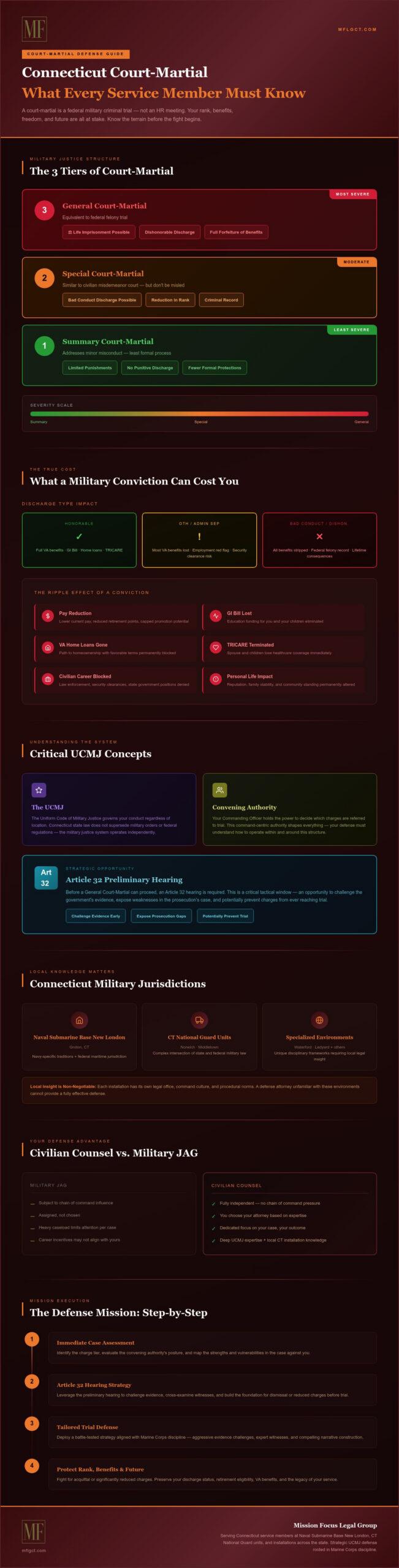
The U.S. Courts-Martial System is structured into three distinct tiers, each with varying levels of severity and procedural protections. A Summary Court-Martial typically addresses minor misconduct and offers the least amount of formal process. A Special Court-Martial is often compared to a civilian misdemeanor court, yet it still possesses the power to issue a Bad Conduct Discharge. The General Court-Martial is the most serious, reserved for felony-level allegations where the penalties can include life imprisonment. Understanding which forum you face is essential for calculating your next tactical move.
The Role of the UCMJ in Military Justice
The Uniform Code of Military Justice provides the legal framework that governs your conduct regardless of where you’re stationed. While you’re physically located in our state, the civilian laws of New Haven or Milford don’t supersede military orders or federal regulations. Your Commanding Officer holds the immense power of the convening authority, meaning they decide which charges are referred to trial. This command-centric system requires a defense that understands how to communicate effectively within the military structure while remaining an unyielding advocate for the accused.
Connecticut Military Hubs and Legal Jurisdictions
Connecticut hosts several unique military environments, each with its own legal nuances. At the Naval Submarine Base New London in Groton, the legal dynamics are heavily influenced by Navy-specific traditions and federal maritime jurisdiction. Conversely, the Connecticut National Guard units from Norwich to Middletown often navigate a complex intersection of state and federal military law. Even the specialized environments near Waterford or Ledyard operate under specific disciplinary frameworks that require local insight. A court martial lawyer Connecticut must be familiar with these specific installations to provide a defense that is both legally sound and culturally informed. We understand the local terrain of these bases and how to navigate the specific legal offices that oversee them.

Call For A Consultation
(860) 333-6455The Professional and Personal Stakes of a Military Conviction
A military conviction is a life-altering event. It doesn’t just end a career; it rewrites your history and strips away the honors you’ve earned through years of dedicated service. When your reputation is on the line, the choice of a court martial lawyer Connecticut relies on becomes the most critical decision of your life. This isn’t just a legal proceeding; it’s a direct assault on your future stability and the well-earned benefits your family depends on every day. We understand that behind every charge sheet is a human being whose entire world is at risk of collapse.
Career-Ending Consequences
Reduction in rank isn’t just a loss of stripes; it’s a tactical defeat for your financial future. The “ripple effect” means lower current pay, reduced retirement points, and a permanent ceiling on your promotion potential. Punitive discharges, such as a Bad Conduct Discharge or a Dishonorable Discharge, are the military equivalent of a felony conviction. Even administrative separations can be devastating. An Other Than Honorable (OTH) discharge often acts as a gatekeeper, blocking access to civilian employment in high-security fields, law enforcement, and state government positions from Milford to West Haven. Many private firms view an OTH as a red flag that disqualifies otherwise capable veterans.
The financial fallout extends far beyond your final active-duty paycheck. A punitive discharge typically results in the total forfeiture of VA benefits. This means losing access to the GI Bill, which could’ve funded your transition or your children’s education, and the loss of VA home loans. Loss of healthcare is another immediate blow. Terminating TRICARE coverage for your spouse and children creates a sudden, overwhelming burden that can fracture a family’s financial foundation in an instant.
Collateral Damage to Personal Life
The impact follows you home to communities like Groton, Mystic, and Norwich. A General Court-Martial conviction often translates directly into a civilian criminal record, which can trigger the loss of your firearm rights and, in some cases, your right to vote. The emotional toll on families stationed near the Sub Base or serving in National Guard units in Middletown is profound. Spouses and children face the uncertainty of sudden relocation, the loss of base housing, and the social stigma that accompanies a military conviction. A court-martial is not just a trial, but a battle for your future.
Your military record is permanent and public. Once a conviction is entered into federal databases, it becomes a visible mark for any background check conducted by Connecticut employers or local licensing boards. Choosing an experienced court martial lawyer Connecticut understands is the first step in mounting a disciplined defense. Protecting your reputation requires a proactive approach that understands the nuances of the UCMJ and the realities of civilian life after service. If you’re facing these life-altering stakes, it’s vital to consult a military law defense professional who can shield your family and your future from this immense collateral damage.

Call For A Consultation
(860) 333-6455Strategic Defense Under the UCMJ: Building Your Mission
A successful defense starts long before the first gavel falls in a courtroom. It requires a level of preparation that mirrors a high-stakes military operation: precise, exhaustive, and mission-driven. When you hire a court martial lawyer Connecticut service members rely on, you aren’t just getting an attorney; you’re gaining a strategist who treats your case with the same discipline you’ve applied to your own service. We don’t wait for the prosecution to set the pace. We seize the initiative by building a comprehensive defense file that challenges every assumption the government makes. This proactive approach ensures that we aren’t just reacting to charges, but actively dismantling them.
Navigating the Article 32 Hearing
The Article 32 Preliminary Hearing is the gatekeeper of the military justice system. Often described as a “mini-trial,” this proceeding is your first and best opportunity to stop the momentum of a court-martial before it reaches a trial phase. Unlike civilian grand juries, you have the right to be present, to be represented by counsel, and to cross-examine government witnesses. Our strategy focuses on exposing the tactical weaknesses in the government’s case during this stage. We use this hearing as a discovery tool to lock witnesses into their testimony and reveal inconsistencies that can be exploited later.
It’s vital to understand the legal threshold here. The government only needs to establish “probable cause” to move forward, which is a relatively low bar. However, by demonstrating that their evidence is too thin to ever reach the standard of “proof beyond a reasonable doubt,” we can advocate for the charges to be dismissed or handled through non-judicial punishment. This stage is about containment and control, preventing a legal fire from becoming a career-ending blaze.
Evidence and Witness Preparation
In the military legal system, your character and your service record are powerful assets. We leverage “Good Soldier” evidence as a shield, using your history of commendations, evaluations, and peer testimony to create reasonable doubt about the allegations. In Connecticut courts, a well-documented character file can be the difference between a conviction and an acquittal. We also employ advanced tools to build your defense, including:
- Digital Forensics: Analyzing communications and metadata to disprove false narratives.
- Witness Statements: Securing testimony from commanding officers and peers who can attest to your integrity.
- Expert Witnesses: Utilizing specialists in toxicology, psychology, or specific military procedures to provide technical clarity.
Every witness we call is thoroughly prepared to handle the pressures of a military trial. We don’t leave anything to chance. By the time we enter the courtroom, we have a clear understanding of the evidence and a calculated plan to counter the prosecution’s narrative. This meticulous preparation is what defines a disciplined defense and protects your rank and reputation.
Why Local Connecticut Civilian Counsel is Vital
Every service member is entitled to a free military defense attorney, known as a Uniformed Defense Counsel. While these JAG officers are often dedicated professionals, they operate within a system that places significant constraints on their time and autonomy. A court martial lawyer Connecticut service members hire independently offers a level of focus and unyielding advocacy that the military system isn’t designed to provide. Most importantly, a civilian advocate operates entirely outside your chain of command. They don’t report to your commanding officer, and their career progression isn’t tied to the very system that is prosecuting you.
Independence is your greatest tactical advantage in a court-martial. When your lawyer isn’t worried about their next fitness report or officer evaluation, they can challenge the prosecution with a level of aggression that a JAG might find career-limiting. This autonomy allows for a defense that’s purely focused on your acquittal and the protection of your future, rather than navigating internal military politics. You need a representative who can look a senior officer in the eye and challenge their narrative without fear of professional reprisal.
Military JAG vs. Civilian Advocate
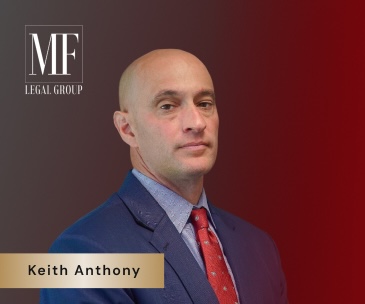
The primary difference between appointed counsel and a private advocate lies in resource allocation and the “fear factor.” JAGs are frequently overwhelmed by staggering caseloads, which can limit the individual attention they can devote to complex forensic evidence or witness preparation. Civilian counsel faces no such limitations. Attorney Keith Anthony’s background as a former Judge Advocate bridges this gap perfectly. He understands the internal pressures of the military legal system but possesses the civilian autonomy to dismantle the prosecution’s case without hesitation. This combination ensures your defense is both culturally fluent and fiercely independent.
The “Home Field” Advantage in Connecticut
Success in military justice often depends on understanding the specific culture of the local legal community. Connecticut is home to unique installations like the Naval Submarine Base New London in Groton and the specialized units found near New Haven and Branford. The Connecticut National Guard also maintains a distinct legal presence with units stretching from Norwich to Ledyard. A local advocate understands the tendencies of regional military judges and the specific nuances of how these local commands handle disciplinary issues. Our proximity to these hubs allows for rapid response and the ability to build a rapport with local military legal offices in places like Waterford or Guilford that an out-of-state firm cannot match.
If you’re facing a trial that could end your career, don’t settle for the path of least resistance. You need a disciplined protector who knows the local terrain and the people within it. Reach out to a court martial lawyer Connecticut trusts to secure a defense that’s as committed to your mission as you are.
Mission Focus Legal Group: Disciplined Advocacy for Your Defense
Mission Focus Legal Group is built on a foundation of military discipline and strategic precision. Attorney Keith Anthony, a U.S. Marine Corps Reserve Major and former Judge Advocate, leads our firm with the same commitment to duty that you bring to your service. As a court martial lawyer Connecticut service members trust, he doesn’t just “handle” cases; he executes a calculated defense designed to protect your career and your family. Having served for over 10 years in Connecticut, we understand the local military landscape and the specific pressures faced by service members at Groton and within the National Guard.
The Marine Mindset Applied to Law
Our approach is rooted in the Marine Corps philosophy of thorough preparation and tactical execution. We treat every legal challenge as a mission where failure is not an option. This means we leave no stone unturned in our investigation and maintain a high-impact presence in the courtroom. Communication is a vital part of this mission. You’ll never be left wondering about the status of your case or the next step in our strategy. This same level of disciplined advocacy extends to our work as an Education Law Attorney Connecticut, where we defend student rights with the same vigor we apply to military courts.
Your Next Steps: The Initial Consultation
The moments following a notification of investigation are the most critical. Your first priority is to exercise your right to remain silent. Don’t attempt to explain your way out of a situation with investigators from NCIS, CID, or OSI without legal counsel present. Statements made in the heat of the moment are often used as the foundation for the prosecution’s case. We provide the steady, calming presence you need to navigate these high-stakes interactions without compromising your future.
When you meet with us for your initial consultation, bring the following items to help us assess your legal mission:
- Your service record (SRB, ORB, or ERB) and latest evaluations.
- Any formal charge sheets or notification of investigation documents.
- A written timeline of events as you remember them.
- Contact information for potential character witnesses who can speak to your service.
Taking these steps immediately helps us gain the initiative. We’ll review your situation with protective confidence and provide a clear explanation of the legal mission ahead. Your rank, your rights, and your reputation are worth defending with every resource available to an experienced court martial lawyer Connecticut. Schedule your confidential military defense consultation today and secure a battle-tested ally for your defense.
Secure Your Legacy and Your Future
Facing a court-martial is a high-stakes mission that requires more than just legal knowledge; it demands a strategist who understands the weight of your service. Your rank, veterans benefits, and future reputation depend on the tactical decisions made in the earliest stages of your case. From dismantling the prosecution’s narrative at an Article 32 hearing to leveraging character evidence, every action must be purposeful and precise. As an experienced court martial lawyer Connecticut service members rely on, we provide the independent, aggressive advocacy necessary to navigate the UCMJ without the constraints of the military chain of command.
Mission Focus Legal Group is led by a U.S. Marine Corps Reserve Major and former Judge Advocate who has served Connecticut service members for over 10 years. We bring a battle-tested mindset to every defense, ensuring that your story is told with clarity and strength. Don’t leave your career to chance or an overwhelmed system. Secure Your Military Defense Strategy with Attorney Keith Anthony today. You’ve spent years building your reputation; let us help you protect it and move forward with confidence.
Military Justice: Frequently Asked Questions
Do I have the right to a civilian lawyer in a court-martial?
You have an absolute right to hire a civilian lawyer at your own expense under the Uniform Code of Military Justice. This choice allows you to select an advocate who is completely independent of your chain of command. While the military provides a JAG attorney, a civilian court martial lawyer Connecticut service members hire independently brings a focused, private-sector perspective to your defense. This ensures that your legal strategist is solely accountable to you and your mission.
What is the difference between a Special and a General Court-Martial?
A Special Court-Martial is generally reserved for intermediate offenses and has limited sentencing power; it is often compared to a civilian misdemeanor court. In contrast, a General Court-Martial handles the most serious allegations, such as felony-level crimes. The General Court-Martial requires an Article 32 preliminary hearing and can result in the most severe penalties, including life imprisonment or a Dishonorable Discharge. Understanding these tiers is vital for calculating your defensive strategy.
Can a court-martial conviction be appealed?
Every court-martial conviction is subject to some form of legal review, and many qualify for a formal appeal. Convictions resulting in a punitive discharge or significant confinement usually trigger an automatic appeal to the service’s Court of Criminal Appeals. For other cases, you can submit a request for review to the Judge Advocate General. We focus on identifying procedural errors or legal insufficiencies that can lead to a conviction being overturned or a sentence reduced.
Will I lose my retirement benefits if I am court-martialed?
A punitive discharge, such as a Dishonorable or Bad Conduct Discharge, typically results in the total forfeiture of your military retirement and VA benefits. Even if you aren’t discharged, a reduction in rank will permanently lower the monthly pay you receive in retirement. Protecting your pension is a primary objective in our defense strategy. We work to mitigate these financial losses by fighting for an acquittal or an administrative resolution rather than a conviction.
What happens during an Article 32 hearing in Connecticut?
An Article 32 hearing is a mandatory preliminary proceeding for General Courts-Martial that takes place at installations like the Naval Submarine Base New London. It serves as a “mini-trial” where a preliminary hearing officer determines if there is probable cause to move forward. This is a critical tactical opportunity for your court martial lawyer Connecticut to cross-examine government witnesses and expose weaknesses in the prosecution’s narrative before the case ever reaches a full trial.
How much does a military defense lawyer in Connecticut cost?
Legal fees for military defense in Connecticut depend on the complexity of the charges and the specific tier of court-martial you face. While we don’t list specific prices, it’s important to view private representation as a tactical investment in your future. A civilian advocate provides resources and individual attention that an overworked JAG office simply cannot match. We encourage you to discuss your specific situation during a confidential consultation to understand the scope of work required.
Can a civilian lawyer represent me at the Groton Sub Base?
Civilian lawyers have the right to represent service members at all military installations, including the Groton Sub Base and the Coast Guard Academy. We frequently appear at Naval Submarine Base New London to advocate for sailors and officers. Being local to the Groton area allows us to respond quickly to developments in your case. We maintain a professional rapport with local military legal offices while remaining a fierce, independent presence in the courtroom.
How does Keith Anthony’s Marine background help my case?
Attorney Keith Anthony’s experience as a U.S. Marine Corps Reserve Major and former Judge Advocate gives him an insider’s understanding of military culture. He knows how commanders think and how the prosecution builds its case because he has been inside those rooms. This background allows him to bridge the gap between military discipline and civilian legal advocacy. He speaks the language of the UCMJ fluently, ensuring your defense is both culturally informed and strategically superior.
Call For A Consultation
(860) 333-6455