Did you know that academic misconduct cases involving AI at the University of Connecticut surged by over 217% between the 2022-23 and 2023-24 academic years? If you’re facing these allegations, a university academic misconduct lawyer CT can provide the strategic defense necessary to protect your record. This sharp increase reflects a broader trend where universities are aggressively policing student behavior using complex, often biased handbooks. When you receive that notification from the Dean’s office, it feels like the ground has disappeared beneath your feet. You’ve invested years of late nights and significant tuition money; now, one allegation threatens to erase it all.
We understand the paralyzing anxiety that comes with the threat of a ruined reputation or a derailed career. It’s natural to feel like the system is rigged against you, especially when university hearings lack the protections of a traditional courtroom. Our mission is to shoulder that burden for you. By reading this guide, you’ll learn how a disciplined legal strategy can help you secure a case dismissal or reduced sanctions while keeping your transcript clean. We’ll walk you through the nuances of the hearing process and show you how a battle-tested advocate can help you reclaim your future.
Key Takeaways
- Academic misconduct allegations at CT institutions like UConn or Yale are high-stakes crises that can derail your career before it begins.
- Modern charges now include AI misuse and digital tracking, making it vital to consult a university academic misconduct lawyer CT who understands these technical traps.
- University hearings often use a lower “preponderance of evidence” standard, so you need a strategy to counter the school’s inherent procedural advantages.
- Effective defense requires a tactical review of your specific student handbook and the immediate preservation of all digital and physical evidence.
- A military-grade approach, led by a former JAG officer, brings the disciplined advocacy needed to navigate complex and often biased university systems.
Call For A Consultation
(860) 333-6455Table of Contents
University Academic Misconduct in Connecticut: A High-Stakes Crisis
Academic misconduct is more than a simple mistake; it’s a formal violation of a university’s honor code or academic integrity policy. In Connecticut, institutions like UConn, Yale, and Quinnipiac have become increasingly aggressive in their enforcement. For instance, UConn updated its policy in 2023 to include broader definitions for misrepresentation and noncompliance. If you’re facing these charges, a university academic misconduct lawyer CT can help navigate the complex disciplinary landscape. This isn’t just about a failing grade. The immediate consequences often include zero grades for assignments, mandatory suspension, or the ultimate “scarlet letter” of expulsion.
For a comprehensive Academic Dishonesty Overview, one can see how these definitions have evolved over decades. Today, a single allegation can trigger a bureaucratic machine designed to protect the school’s reputation, often at the expense of the student’s rights. You aren’t just fighting a teacher; you’re fighting an institution with vast resources.
Academic Integrity Standards in CT Higher Education
Higher education in Connecticut demands a level of precision that many students haven’t encountered. At Yale or UConn, “dishonesty” extends far beyond simple cheating. It includes unauthorized collaboration or failing to cite a source perfectly. These cases are managed by the Dean of Students or an Academic Honor Board, which functions as a quasi-judicial body. A common mistake students make is assuming that “I didn’t know the rule” works as a defense. In a university hearing, ignorance is never a valid excuse; you’re expected to know every line of the student handbook from day one.
The Permanent Transcript Stain: Why You Can’t Just “Wait and See”
Waiting to see how the school “handles it” is a dangerous gamble. A misconduct notation on your transcript acts as a permanent barrier. It can block your path to medical school, law school, or obtaining professional licenses in fields like nursing or accounting. Beyond the career damage, the financial stakes are massive. If you’re expelled, you likely lose your tuition for the semester without any hope of a refund. This is why securing a university academic misconduct lawyer CT is critical at the first sign of trouble. Early intervention allows for evidence preservation and the development of a disciplined defense before the board reaches a predetermined conclusion. You need an ally who understands the regional academic landscape from New Haven to Storrs and will fight to keep your record clean.

Call For A Consultation
(860) 333-6455Common Charges: From Plagiarism to AI-Generated Dishonesty
Plagiarism has evolved far beyond simple copy-pasting. In today’s academic environment, institutions use sophisticated scanning software to detect “self-plagiarism,” where a student submits their own past work for a new assignment without permission. Universities also watch for fabrication, such as altering lab results or submitting forged medical notes to justify absences. These actions can trigger a full investigation by the Honor Board, putting your entire academic career at risk. Schools are increasingly aggressive, viewing even minor citation errors as evidence of intent to deceive. If you find yourself in the crosshairs of an investigation, securing a university academic misconduct lawyer CT is the first step toward a disciplined defense.
Challenging AI Misconduct Allegations
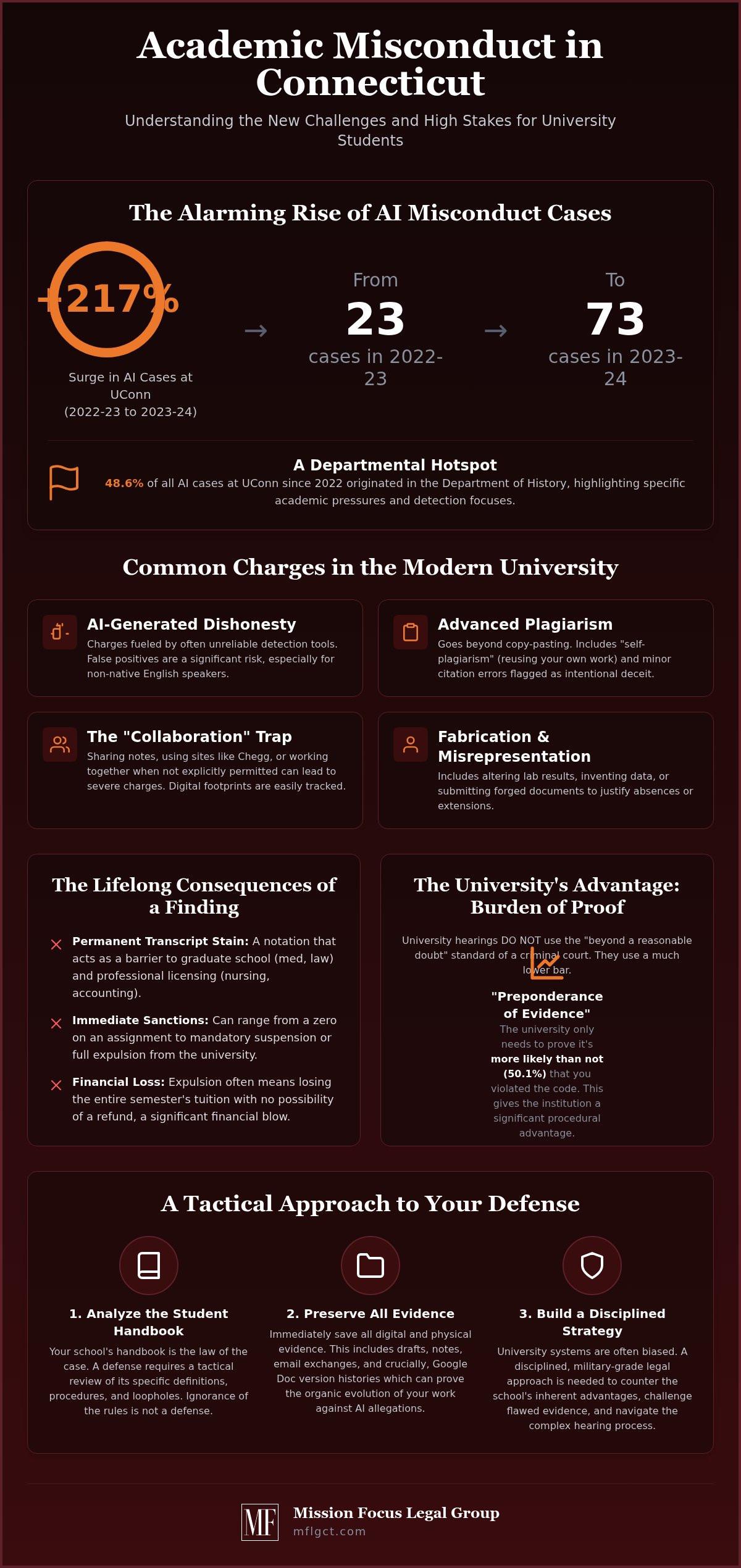
AI is the new frontier of academic discipline. Between the 2022-23 and 2023-24 academic years, AI-related cases at UConn jumped from 23 to 73. This 217.4% surge is fueled by unreliable detection tools that professors often treat as infallible. If you’re in the Department of History, you’re at a statistically higher risk; nearly 48.6% of all AI cases at UConn since 2022 originated there. You can counter these claims by producing Google Doc version histories or initial draft logs that prove the organic evolution of your ideas. It’s a technical battle that requires a university academic misconduct lawyer CT to expose the software’s high error rates. AI detectors often produce false positives for non-native English speakers.
The “Collaborative” Cheating Trap
Digital footprints are permanent and easily tracked. Platforms like Chegg and Course Hero often comply with university subpoenas, handing over IP addresses, account names, and timestamps. Similarly, GroupMe or WhatsApp threads can turn a private study session into a mass misconduct charge. If you shared a finished assignment “just for reference,” the school may punish you more harshly than the person who used it. Universities view the source of the information as the primary instigator of “unauthorized collaboration.”
Understanding the specific boundaries of your program is essential for survival. For example, UConn Law’s Academic Misconduct Policy explicitly bans generative AI unless an instructor gives prior permission. These rules change frequently, leaving students vulnerable to shifting standards. If you’re caught in this crossfire, don’t provide a statement until you’ve consulted with a professional who knows how to dismantle these technical allegations. Protecting your future requires a strategic, mission-driven approach to every piece of evidence the school claims to have.
Call For A Consultation
(860) 333-6455The Hidden Risks of University Disciplinary Investigations
University investigations are not fair fights. They don’t follow the “beyond a reasonable doubt” standard you see on television. Instead, Connecticut schools use a “preponderance of evidence” standard. This means if the board is just 51% convinced you committed a violation, you lose. It’s a razor-thin margin where a single misinterpreted email can end your academic career. You are facing a system that prioritizes institutional reputation over individual student rights.
The system is designed to favor the university. You don’t have the same “discovery” rights as a defendant in a criminal case; schools frequently hide evidence until the moment the hearing begins. Many universities also try to minimize the role of legal counsel, labeling them as a “support person” to prevent them from speaking during the proceedings. This procedural bias makes hiring a university academic misconduct lawyer CT a strategic necessity rather than an option. You are walking into a system that isn’t looking for the truth; it’s looking for a resolution that fits its internal narrative.
There is also the silent threat of self-incrimination. Anything you say in a university hearing can be used against you in a criminal court if the allegations involve fraud, computer crimes, or physical altercations. You aren’t just protecting your transcript; you’re protecting your liberty. Without a disciplined defense, a simple explanation to a Dean can become a confession used by a prosecutor.
The Investigation Phase: Where Cases are Won or Lost
The first meeting with a Dean is often a trap. They’ll frame it as an informal conversation to “clear things up,” but their goal is often to secure a confession before you realize the stakes. Never walk into these interviews without reviewing your case file first. You have a right to see the evidence they’ve gathered, including witness statements and digital logs. We help students handle these interviews with a disciplined approach, ensuring they don’t provide the school with the ammunition needed to secure a conviction. Early intervention is the key to preventing a minor inquiry from escalating into a full-scale disciplinary crisis.
FERPA Rights and Your Academic Record
The Family Educational Rights and Privacy Act (FERPA) is your primary shield in Connecticut. It grants you the right to inspect and review your educational records, a critical tool when building a defense. While schools can be protective of their internal files, FERPA forces transparency. It also limits what the university can disclose to third parties, though there are significant exceptions for law enforcement. Understanding these boundaries allows a university academic misconduct lawyer CT to control the narrative and keep your private information from leaking into the professional sphere.
Building Your Defense Strategy: A Tactical Approach
A successful defense isn’t built on luck; it’s forged through disciplined preparation. You must first master your school’s Student Handbook, which serves as your specific rules of engagement. Whether you’re at UConn or a smaller private college, these documents outline the procedural requirements the administration must follow. If they skip a step or ignore a deadline, that’s a tactical opening for your defense. You need to gather every email, timestamp, and witness statement immediately. Evidence vanishes quickly in a digital environment; therefore, preservation is your first priority. You can’t rely on the school to keep records that might exonerate you.
We focus on a critical narrative shift. Most students walk into hearings ready to apologize, hoping for mercy. This is a tactical mistake. We move the conversation from “I’m sorry” to “The evidence does not support the charge.” This objective stance forces the university to meet its burden of proof rather than relying on your admission of guilt. We prepare you through rigorous mock questioning and opening statement refinement so you aren’t surprised by the board’s aggressive tactics. A university academic misconduct lawyer CT ensures your story is told with precision, strength, and a focus on the facts.
Analyzing the University’s Evidence
We scrutinize the school’s case for inconsistencies. Professor testimony and digital logs often contain gaps that can be exploited during the hearing. Exculpatory evidence is any information that tends to justify or excuse your actions, proving you didn’t commit the alleged violation. We also challenge the “expertise” of those accusing you. Just because a Teaching Assistant claims a paper looks like AI doesn’t mean they have the technical background to prove it. We look for technical flaws in the software used to flag your work, turning their own tools against them to create reasonable doubt.
The Role of Your Academic Misconduct Lawyer
A university academic misconduct lawyer CT acts as a vital buffer between you and an aggressive administration. We handle the drafting of formal responses and appeals that specifically cite university policy violations. This professional distance prevents you from being bullied into a corner during high-stakes meetings. We also coach you on how to remain calm under the high-pressure environment of a hearing. It’s about maintaining a steady, professional presence while the school tries to break your resolve. If you’re ready to build a strategic defense, contact our team today to secure your future. We bring the investigative experience of a former JAG officer to every case, ensuring no detail is overlooked and every procedural right is defended.
Mission-Driven Advocacy for Connecticut Students
Attorney Keith Anthony brings more than a decade of service to every case he handles. As a U.S. Marine Corps Reserve Major and former Judge Advocate (JAG), he approaches academic defense with a specific brand of strategic discipline. We don’t simply “manage” cases; we execute a mission to protect your future. This approach is rooted in the belief that a student’s honor, academic record, and career prospects are worth a vigorous, battle-tested defense. When the stakes are this high, you need a university academic misconduct lawyer CT who understands how to navigate a system that often feels stacked against the individual.
Our local expertise spans the entire state, from the ivy-covered walls of New Haven to the specialized programs in Groton. We understand the regional academic landscape and the specific pressures students face at Connecticut’s premier institutions. By treating your defense with the same seriousness as a military or criminal case, we ensure that no procedural stone is left unturned. We focus on protecting the “Whole Student,” recognizing that an allegation of dishonesty can have psychological and professional ripples that last for years if not handled with precision.
Why a Former JAG Officer is Your Best Advocate
There is a striking similarity between military administrative boards and university conduct hearings. Both operate outside the traditional protections of a courtroom, and both require an advocate who can navigate complex, internal regulations. Attorney Keith Anthony’s experience in high-stakes investigations allows him to identify weaknesses in the school’s narrative that others might miss. He knows how to command respect in a room full of university administrators, ensuring your voice is heard and your rights are respected. This background provides a level of stability and authority that is essential when facing an aggressive university board.
Contact Mission Focus Legal Group Today
Time is your most valuable asset when facing misconduct charges. Don’t wait for the formal expulsion notice to arrive before you take action. Early intervention is the most reliable way to secure a favorable outcome, as it allows us to control the narrative and preserve evidence before it’s lost. We serve students in New Haven, Groton, and across the state, providing a steady hand during a period of intense uncertainty. If you’re ready to mount a disciplined defense, schedule your confidential consultation with Attorney Keith Anthony. Let a university academic misconduct lawyer CT carry the burden of this fight so you can focus on reclaiming your future.
Defend Your Reputation and Reclaim Your Future
Facing university misconduct charges is a high-stakes mission where your career is the primary collateral. We’ve discussed how Connecticut institutions use aggressive enforcement and unreliable tools like AI detectors to pressure students into damaging admissions. You don’t have to navigate this biased system alone. By mastering the student handbook and preserving evidence early, you can shift the narrative from a plea for mercy to a disciplined, evidence-based defense. Your future is too valuable to leave to the discretion of an administrative board.
Attorney Keith Anthony brings over 10 years of aggressive advocacy and the strategic discipline of a former Marine Corps Judge Advocate to your side. When you hire a university academic misconduct lawyer CT, you aren’t just getting legal advice; you’re gaining a battle-tested protector who knows how to command respect in a room full of administrators. We specialize in education law and the protection of student rights, ensuring your voice is heard and your record remains clean. Secure your academic future with strategic defense; contact Mission Focus Legal Group today. You’ve worked too hard to let one allegation define your life; let’s fight to keep your path clear.
Frequently Asked Questions
Can a lawyer attend my university disciplinary hearing in Connecticut?
Yes, though the specific role varies by institution. Most Connecticut schools allow you to bring an advisor of your choice, which can be an attorney. However, universities often limit the lawyer to a non-speaking role during the actual hearing. You need a university academic misconduct lawyer CT to act as your silent strategist, ensuring you follow a disciplined script while we monitor for procedural violations that could form the basis of a future appeal.
What happens if I am found responsible for academic misconduct?
Sanctions range from a failing grade on a single assignment to immediate expulsion from the university. A permanent notation is typically placed on your transcript, acting as a warning to future employers and schools. Beyond academic penalties, you may face the loss of institutional scholarships or the revocation of previously earned credits. We fight to minimize these outcomes, focusing on securing a resolution that preserves your long-term career viability and honor.
Can I appeal a university’s decision if I lose my hearing?
Most Connecticut universities provide a narrow window for appeals, often just five to ten business days after the decision. Grounds for appeal are usually limited to procedural errors, the discovery of new evidence, or disproportionate sanctions. You can’t appeal simply because you disagree with the result. We analyze the hearing transcript to identify specific violations of the student handbook, drafting a formal appeal that demands a re-evaluation based on institutional failure.
Will a misconduct charge on my record prevent me from going to grad school?
It creates a significant hurdle but isn’t always an absolute bar to admission. Graduate schools and professional licensing boards, such as the Bar or Medical Board, require full disclosure of your disciplinary history. A charge of dishonesty can lead to an automatic rejection if it isn’t addressed strategically. We help you draft addendums that frame the incident in a way that emphasizes growth and accountability, minimizing the risk to your professional reputation.
Is using ChatGPT or AI detectors considered academic misconduct in CT?
Yes, if the instructor hasn’t explicitly authorized AI use for that specific assignment. Institutions like UConn and Yale have updated their policies to treat unauthorized generative AI use as a form of misrepresentation. However, AI detectors are notoriously unreliable and prone to false positives. We challenge these allegations by demanding the university prove the technical validity of their tools, often exposing the lack of scientific consensus behind the software’s certainty scores.
What is the “Preponderance of the Evidence” standard in school hearings?
This is a “more likely than not” standard, meaning the board only needs to be 51% certain of your guilt to impose sanctions. This is much lower than the “beyond a reasonable doubt” standard used in criminal courts. Because the margin for error is so slim, your defense must be airtight from the start. We focus on creating enough doubt to shift that percentage back in your favor through rigorous analysis of the university’s evidence.
Should I talk to the Dean of Students before hiring a lawyer?
No. Anything you say to the Dean or a university investigator can be used as evidence against you in the hearing. They often frame these meetings as “informal chats” to encourage you to lower your guard and admit to violations. You should decline any substantive discussion until you have consulted with a university academic misconduct lawyer CT. We provide the buffer you need to avoid accidental self-incrimination during the early investigation phase.
How long does a university academic misconduct investigation usually take?
Investigations typically last between thirty and sixty days, though complex cases involving multiple students can take longer. The process moves quickly once the initial notification is sent to the student. You’ll often have only a few days to review the evidence file before the hearing date is finalized. This rapid timeline requires an immediate, disciplined response to ensure your defense is fully prepared before the university’s internal clock runs out.
Call For A Consultation
(860) 333-6455